Showing posts with label costume. Show all posts

Wednesday, March 2, 2022

Top Fifteen Most Requested Books in the Art, Music and Recreation Center, March 2022


Often rock memoirs top these lists of titles most in demand (think of books like Just Kids by Patty Smith, Life by Keith Richards, or Girl In A Band by Kim Gordon). With by far the longest waiting list of any of our books, Crying in H Mart by Michelle Zauner is not only a rock music memoir as an Asian-American's poignant tale of coming of age through adversity. 

There are a number of other memoirs among current titles including 1000 Years of Joys and Sorrows by artist Ai Weiwei, All About Me! by writer and director Mel Brooks, The Chiffon Trenches by fashion journalist André Leon Talley, Will by actor Will Smith, Putting The Rabbit in the Hat by actor Brian Cox, Enough Already by actress Valerie Bertinelli.

Worn is an wide-ranging socio-cultural history of clothing. The Method traces the history and influence of this school of acting. The mystery behind a posthumously famous photographer is revealed in Vivian Maier Developed. Camera Man focuses on actor and director Buster Keaton to examine societal and technological developments in the early 20th century.  Dilla Time provides both a biography and musical analysis of the late hip hop producer J Dilla.

Two sports and recreation books complete the list. Blood In The Garden tells the tale of the NBA's rugged New York Knicks of the early 1990s.  Seven Games traces the history of the enduringly popular, but less than rugged, games of checkers, backgammon, chess, go, poker, scrabble, and bridge.


1. Crying in H Mart: A Memoir by Michelle Zauner (Alfred A. Knopf, 2021).

2. 1000 Years of Joys and Sorrows: A Memoir by Ai Weiwei, translated by Allan H. Barr (Crown, 2021).

3. All About Me!: My Remarkable Life in Show Business by Mel Brooks (Ballantine Books, 2021).

4. The Chiffon Trenches: A Memoir by André Leon Talley (Ballantine Books, 2020).

5. Worn: A People's History of Clothing by Sofi Thanhauser (Pantheon Books, 2022).

6. The Method: How The Twentieth Century Learned To Act by Isaac Butler (Bloomsbury Publishing, 2022).

7. Will by Will Smith with Mark Manson (Penguin Press, 2021).

8. Putting The Rabbit In The Hat: A Memoir by Brian Cox (Grand Central Publishing, 2022).

11. The Beatles: Get Back by the Beatles featuring photography by Ethan A. Russell and Linda McCartney, edited by John Harris from transcripts of the original sound recordings. (Apple New York, 2021).

12. Enough Already: Learning To Love The Way I Am Today by Valerie Bertinelli (Mariner Books, 2022).

13. Dilla Time: The Life and Afterlife Of J Dilla, The Hip-Hop Producer Who Reinvented Rhythm by Dan Charnas with musical analysis by Jeff Peretz (MCD / Farrar, Straus and Giroux, 2022).

15. Seven Games: A Human History by Oliver Roeder (W.W. Norton & Company, 2022).

See also:

Saturday, June 11, 2016

Fashion Archives from Proquest


We are very pleased to announce the addition of the Fashion Archives from Proquest to our list of full-text databases! With high-resolution color and article-level indexing, the online archives provide unprecedented historical coverage of leading fashion and women’s magazines.  The Fashion Archives collection includes:

The Harper's Bazaar Archive

A comprehensive, searchable archive of every page, advertisement, and cover of every issue of Harper's Bazaar from its first appearance in 1867 to the current month. Reproduced in high-resolution color page images and supported by fully searchable text and indexing, this resource provides access to a chronicle of 20th century American and international fashion, culture, and society, supporting researchers by offering a cultural lens into the modern era.
Coverage: 1867 - current

The Vogue Archive

A complete searchable archive of American Vogue, from the first issue in 1892 to the current month, reproduced in high-resolution color page images. Every page, advertisement, cover and fold-out has been included, with rich indexing enabling you to find images by garment type, designer and brand names. The Vogue Archive preserves the work of the world's greatest fashion designers, stylists and photographers and is a unique record of American and international fashion, culture and society from the dawn of the modern era to the present day. Coverage 1867 - current.


Women's Magazine Archive

An archival research resource comprising the full backfiles of leading women’s interest consumer magazines. Titles are scanned from cover to cover in high-resolution color and feature detailed article-level indexing. Coverage ranges from the late-19th century through to 2005 and these key primary sources permit the examination of the events, trends, and attitudes of this period. Among the research fields served by this material are gender studies, social history, economics/marketing, media, fashion, politics, and popular culture.  SOme titles included are Better Homes and Gardens, Ladies Home Journal and Redbook.

The Women's Wear Daily Archive

A comprehensive archive of Women’s Wear Daily, from the first issue in 1910 to material from within the last twelve months, reproduced in high-resolution images. Every page, article, advertisement and cover has been included, with searchable text and indexing. The Women’s Wear Daily Archive preserves one of the fashion industry's most influential reads. Key moments in the history of the industry, as well as major designers, brands, retailers and advertisers are all covered in this publication of record.


Also included in this collection is the Design and Applied Arts Index which is not full text.  We do however own many of the journals and books in print.

Design and Applied Arts Index (DAAI)

This database is the premier source of information for all aspects of design and crafts, from textiles and ceramics to vehicle design, advertising and sustainability. Covers journal articles, exhibition reviews and news items from 1973 to the present.
Coverage: 1973 - current

How to search:

Go to sfpl.org and hover over eLibrary then click on "Articles and Databases".  Choose "Topics" then click on "Art & Music".


Each of these databases can be searched individually or concurrently.  By clicking on "Fashion Archive" you are taken to a search screen that limits the search to only the five databases listed above.  There is a basic search screen which is a keyword search and an Advanced Search screen that allows for more focused searching and results.


In the Advanced Search it is possible to limit to document type such as advertisement, catalog, correspondence, fiction, interview and many more.  The advanced search defaults to a keyword search but can be narrowed down to author, title, publication name, document text, etc.

An Advanced Search for "Hemline" and limited to Advertisement reveals this 1928 Lord and Taylor advertisement from Vogue:

Advertisement: Lord & taylor. (1928, Jan 01). Vogue, 71, 34. Retrieved from http://ezproxy.sfpl.org/login?url=http://search.proquest.com/docview/904318506?accountid=35117
Another search limiting to "Article" reveals over 3,000 results including this 1928 article in the "Styles for Smaller Women" section of Women's Wear Daily.

Styles for smaller women: Afternoon frocks retain uneven hemline for spring. (1928, Nov 26). Women’s Wear Daily, 37, 1. Retrieved from http://ezproxy.sfpl.org/login?url=http://search.proquest.com/docview/1653748519?accountid=35117


Wednesday, September 2, 2015

Christian Dior and The New Look


Come to the Art, Music and Recreation Center on the 4th floor of the Main Library to see a small exhibit on the life of Christian Dior and his famous New Look.

Christian Dior was 42 years old when he presented his first collection. He became a fashion designer after a good but unremarkable career as an art dealer. He had no formal training and only a couple of years’ experience in design. He died just ten years after opening the House of Dior. In those ten years he profoundly changed the course of fashion history.

The New Look debuted in 1947, just 18 months after the end of World War II. The timing was inconceivably bold. The long years of war had devastated the French fashion industry and couture in particular. Severe shortages of clothing and shoes led to worldwide rationing. In the United States, laws were passed specifying fabric consumption for every article of clothing. Shortages were even more severe in Europe. Leather shoes and stockings were virtually unobtainable. Silk was restricted to war uses. Most men were in the military, and women stepped in, filling jobs formerly open only to men, many in manual labor. Due to gas rationing, transportation was largely by foot or bicycle. As a result, a typical woman in the 1940s wore cork or wooden soled shoes, bare legs, a straight knee length skirt or bicycle-friendly trousers, and a masculine, padded-shoulder jacket with military detailing. With so many shortages women expressed their femininity through whimsical hats and piled up long hair.

Dior’s first collection, named Corolle (flower petals) was quickly dubbed The New Look by Carmel Snow, editor of Harper’s Bazaar. It was an instant sensation. For the first time in history fashion was front page news. It was the antithesis of everything women had been wearing for the previous eight years. With small rounded shoulders, full bust, corseted wasp waist, padded hips and lavish, ankle grazing full skirts, its hour glass silhouette was exuberantly feminine. Dresses frequently used more than 30 yards of fabric.

The Bar Suit is the most iconic image of 1947’s New Look. It has all of the New Look elements: small shoulders, full bust, wasp waist, padded hips, and long full skirt.

In his very first presentation Dior reestablished Paris as the heart of fashion innovation and quality. He used the most luxurious textiles from French mills. His collections, all made by hand, were embellished with beading, embroidery, fur and other extravagant details. Styles were always presented with matching shoes, hats, gloves and other accessories. This revitalized crafts that had disappeared during the war and insured the livelihood of many thousands of skilled artisans. He brought French couture back from the brink of extinction.

Hand beading and hand embroidery were added after the dresses were made so that the motifs reinforced the silhouette and accentuated the shape of the body beneath.

Although it was wildly successful, The New Look was controversial. American women picketed Dior on his first trip to the United States. They formed the “Little Below the Knee Club” claiming that the amount of yardage used in his skirts was wasteful and hid their legs.

Dior was also a brilliant and innovative business man. He was the first couturier to develop licensing agreements as we know them. His label was on ties, furs, hats, corsets, hosiery and more. This practice, now ubiquitous, was denounced by the French Chamber of Couture as “degrading to the Haute Couture image.” He was the first to open lower priced boutiques and to create a global brand with stores in North and South America, Asia and Australia. He had a keen instinct for promotion. He pioneered the now common practice of lending couture fashions to celebrities and models to wear to public events. Traditionally couturiers created a signature look that gradually evolved over time. In order to keep interest in The House of Dior alive, Dior created a new silhouette every season, always making front page news. Each collection had new proportions and was eagerly embraced by women around the world. By the mid-1950s Dior products generated 50% to 75% of France’s clothing exports, and 5% of the total of all French exports.


Dior created a new silhouette every season. Each collection was named for its key shape.

Dior was also skilled at recognizing and nurturing talent in others. When he met 18 year-old Yves Saint-Laurent he hired him on the spot. Pierre Cardin also worked for Dior in the 1950s. In a move unusual for the time, he placed women, including his sister and a childhood friend, in executive positions. In addition, Dior was one of the first designers to feature Asian models. He was known for creating a family atmosphere among his employees.

For ten years Dior had a golden touch. It’s impossible to know where his talent might have led fashion. His last collection in 1957 with its youthful chemise silhouette and bright colors anticipated the look of the 1960s. After fitting the autumn 1957 collection, Christian Dior died of a heart attack. He was 52 years old. Privately, he was known as a shy, sentimental, warm-hearted, provincial man, adored by his staff, who loved spending time in his garden. Publicly, he was a brilliantly inspired designer, and a pioneering businessman who will forever be remembered as the man who saved French couture.

For more information on fashion in the 1940s browse Dewey call number section 391 – 391.4.  For more information on Christian Dior browse Dewey call number 746.9209.

All images shown were sourced from books in the collection at The Art, Music and Recreation Center at the San Francisco Public Library.

Some of our favorite books on Dior:

Dior Impressions: The inspiration and influence of impressionism at the House of Dior (Rizzoli, 2013).

Inspiration Dior (Abrams, 2011).


Vogue on Christian Dior (Abrams Image, 2014).

Monday, May 19, 2014

Clothing, Dress, Fashion, Costume. Where Do You Start Your Research?

According to the Dewey Decimal books with the subject heading for “Costume and Personal Appearance” receive a 391 call number. The terms Clothing, Dress, Fashion and Costume are often used interchangeably. They all refer to items that are used to cover or decorate the body. A keyword search for "fashion" will also bring up fashion designers and styles of clothing used by a particular group of people over a specific period of time. Costume generally means clothing of the past, but can also refer to clothing worn by people in the performing arts. Because of this confusion, this term seems to be falling out of favor in reference books. If you’re looking for encyclopedias or dictionaries on costume history, clothing from different countries or definitions of types of garments, you might try a keyword search like “clothing" or "dress.” This will locate books using either term.

When you begin your research, just browsing the right shelf area is often more effective than an online catalog search. If you’re not exactly sure what you need, an excellent place to start is the Art, Music and Reference Center room reference section, Dewey number 391.003 on the fourth floor, row 55. This is the call number for dictionaries and encyclopedias of costume. Among other general clothing reference works we have three outstanding sets of encyclopedias. Each set has a different way of organizing information and a slightly different focus:


Encyclopedia of Clothing and Fashion, (in 3 volumes) Valerie Steele, editor in chief (Charles Scribner's Sons, 2005). Also available online with your San Francisco Public Library library card through the Gale Virtual Reference Library.

This is a broad-based encyclopedia with a straightforward alphabetical format. It provides an in-depth survey of clothing and body adornment. It also examines the origins of clothing, the development of fabrics and technologies, and the social meanings of dress.

This encyclopedia presents information on representative costumes from a wide variety of historical eras. Topics range from the bustle, sari, and toga to Polyester and body piercing, the cocktail dress, bathing suit, burqua, and the Nehru jacket. There are also entries for techniques and manufactures such batik, dry cleaning, zipper, stone washing, for body adornment such as makeup, masks, tattooing, and wigs, as well as for important persons and institutions like Coco Chanel, Edith Head, Yves Saint-Laurent, and Fashion Institute of Technology.

The longer essays provide a wider cultural context: class, gender, sumptuary laws, costume design for stage and screen, advertising, fashion careers, ecclesiastical dress, etc. It includes a comprehensive general index in the last volume, as well as a timeline, and a topical outline.

The editor in chief, Valerie Steele, is chief curator and director of The Museum at the Fashion Institute of Technology. She is a widely respected authority on fashion and clothing history. We have many books written or edited by her and they are all well-researched, well-written and useful for the casual or serious researcher.

Some of the strengths of this set are the easy to search A to Z format and the inclusion of a bibliography for each entry, both for sources and further research. This is also the only one of the three sets that includes contemporary fashion subjects. For example, a four page article on crowns and tiaras describes new tiara trends started by Vivienne Westwood and Gianni Versace.

The index at the end of the third volume is superlative. In addition to the conventional uses of an index, a quick browse through this could give you new directions for your research.  The outline at the end of the same volume is divided into seven broad subject areas and then subsequent categories within each topic. Since the encyclopedia entries are in A to Z format, the outline is helpful in finding related articles. If you need help in structuring a report, this outline will help as well.


Encyclopedia of National Dress: Traditional Clothing Around the World (in 2 volumes), Jill Condra, editor (ABC-CLIO, c2013).

This set has entries for 130 nations or autonomous regions listed alphabetically. It examines clothing in the context of the cultural identity of people who live in regions all over the world, providing a historical and geographic perspective that illustrates how people dress and explains the reasons behind the material, design, and style.  Each entry in the encyclopedia includes a short historical and geographical background for the topic before discussing the clothing of people in that country or region of the world. This work will be of great interest to students researching fashion, fashion history, or history as well as to general readers interested in anthropology, textiles, fashion, ethnology, history, or ethnic dress.

This resource has many strengths.  Each entry has a list of “Further Reading and Resources” list at the end citing both print and online sources for more in-depth research. The information is detailed, but still appropriate for middle school through undergraduate level searchers.  Each entry begins with the historical, geographical and environmental background, which is then tied in to how these affect the textiles used and the clothing worn.  There is also an explanation of the difference between everyday and special-occasion dress. The rituals and special occasions important to each country are described.

At the end of the 2nd volume there is a list of museums with national dress and textile collections.


Encyclopedia of World Dress and Fashion (Oxford University Press, 2010).

The 10-volume Encyclopedia of World Dress and Fashion, the most comprehensive reference work of the three, explores all aspects of dress and fashion globally - from pre-history to the present day. Arranged geographically, the first 9 volumes each cover a region of the world. Volume 10 is on global perspectives. This work is written by an international team of experts, and is the most in-depth source for all issues relating the art and anthropology of costume, dress, and fashion for students, scholars, members of the design and fashion industries, and fashion aficionados. All articles have been specially commissioned from over 600 renowned scholars from every part of the globe. Particular effort has been made to commission articles by indigenous scholars with in-depth local knowledge.

This set also has many strengths. It is the most scholarly of the three encyclopedias and is recommended for the serious researcher.  Each volume begins with general regional view, but then drills down to an exceptionally detailed view of each country. This work provides the sometimes hard-to-find information on contemporary design, trade and present day influences of dress for all regions of the world.  The Contributors are extremely knowledgeable about the technical aspects of textiles and clothing construction.  Many disparate elements such as religion, colonialism, natural resources, the significance of iconic garments and the importance of key colors are explained in relation to each other and create a deeper understanding of the culture. Volume has unique and thought-provoking essays on global perspectives. It addresses world influences and trends. There is also a timeline and a cumulative index.

Tuesday, November 19, 2013

Icons of Men's Style

How did the Pea Coat get its name? Who designed “Chuck Taylors”? Why do surfers wear shirts designed for lumberjacks? The answers to all of these questions can be found in Icons of Men’s Style by Josh Sims.

Icons of Men’s Style examines how these and many of the other items found in a man’s closet came to be there. While women’s wardrobes tend to chase the whims of fashion, men’s clothing is likely to evolve from functional uses. Details and fabrics from clothing specifically designed for sport, work or the military have become so ubiquitous that the original uses have been long forgotten.

The pea coat’s history explains many of its distinctive features. First of all, the name has nothing to do with farming or vegetables. The original version of the pea coat was designed in 1857 by the British Royal Navy and was adopted with modifications by the United States Navy in about 1881. There are two theories about how the coat got its name. Some historians say that it’s a misspelling of P-jacket, or “pilot’s jacket”, although it was used by all ranks in the military. Alternatively, the name may come from pij “a coarse wool cloth woven in the Netherlands … and used for a typical worker’s jacket called a pijakker.”

Since the pea coat originated in the days of the schooner the details that give it such a stylish design were built into the coat for purely functional purposes. The extra thick wool, double breasted closure and the extra tall collar were made to protect sailors from icy cold winds at sea. By moving the buttons to the side, they were less likely to get caught in the rigging ropes. The length of the coat was carefully calculated. It is long enough to protect against cold and short enough to provide ease of movement. The dark indigo color, now known as navy blue, was chosen for entirely pragmatic reasons. It doesn’t show dirt, and at the time the coat was designed there were no colorfast dyes. Indigo "was the shade most resistant to being faded by sunlight and repeated drenching by rain and by seawater."

Converse Chuck Taylor All Star athletic shoes were named for the famous basketball player Charles “Chuck” Taylor, but any resemblance to Michael Jordan’s endorsement deals ends there. Chuck Taylor approached the Converse Rubber Shoe Company in 1921 looking for a job. He was hired as a salesman. He brought with him suggestions for how to improve their existing All Star basketball shoe. One suggestion was a round patch on the side of the high top to protect a player’s ankles. He sold All Stars for nearly 10 years before his name was added to the shoe. Through his efforts, his namesake shoe became the official physical training shoe for the United States Army. The forerunner of the NBA, the National Basketball League, also adopted Chuck Taylors as their official shoe. The shoes were only offered in black until 1947 when the company added white. It wasn’t until 1966 that seven new colors were added. Taylor sold shoes for Converse until his death in 1969, never receiving any commission for the shoe that bears his name.

The original lumberjack shirt was made in a heavyweight, scratchy wool in plain neutral colors. It wasn’t until 1924 when a family-owned business in Pendleton Oregon made a few key design changes that the lumberjack shirt became popular with non-lumberjacks. The Pendleton shirt was made in a lighter weight, softer virgin wool in colorful plaids. With very few changes it is the same shirt worn today. Surfers in Southern California adopted it in the early 1960s as a warm cover-up at the beach. Later in the 1960s a group called The Pendletones adopted their name in honor of this surf icon. They later changed their name to The Beach Boys.

Other fascinating and sometimes surprising information can be found in the stories of the necktie, the driving shoe, Y-fronts and many other icons of menswear that are defined in Icons of Men’s Style.

Icons of Men's Style by Josh Sims (Laurence King Pub., 2011).

Thursday, January 3, 2013

Why is information on clothing in three different places in the library?

Dewey Decimal numbers 391, 646.3 and 746.92 all have information about clothing. There are fine distinctions separating them; unfortunately there are also some gray zones where they overlap.  The San Francisco Public Library has many titles that illustrate this. A brief explanation about the Dewey Decimal Classification System will help clarify the situation.

The Dewey Decimal Classification System, Dewey for short, is the most commonly used way for public libraries to organize non-fiction books by subject. It was invented and copyrighted in 1876 by 21-year-old Melvil Dewey. In order to stay current with contemporary needs, it was designed with built-in methods for adding new subjects and revamping subject terms. The twenty-third edition was just published in 2011. Today every book copyrighted in the United States is assigned a standardized Dewey number by the Library of Congress. That means that the same title will be found in the same place in public libraries as far apart as San Francisco, Boston and Anchorage. For a technology invented by one individual 136 years ago it has held up surprisingly well. In some areas though, it’s beginning to show its age. The confusion over the three clothing classifications is a perfect example of how a concept that was entirely clear in Dewey’s Victorian era has caused some understandable mystification in our 21st century.

The 300’s section of the library represents “Social Sciences.” The 391 subsection is assigned to “Costume and Personal Appearance”. The word costume itself is the beginning of the confusion. In modern usage costume usually refers to a disguise, as in a Halloween costume. In Dewey’s time, and in the system today, the main definition is simply a style of dress, especially that specific to a time, group or historical period.  In the 391s you’ll find titles like Women From the Ankle Down: The Story of Shoes and How They Define Us by Rachelle Bergstein (391.413) and Imperial Chinese Robes From the Forbidden City, edited by Ming Wilson with the Palace Museum, Beijing (391.0095). Falling into the personal appearance part of the 391s is 500 Tattoo Designs by Henry Ferguson (391.65)


The 600’s section comprises “Technology (Applied Science).”.You can imagine how much this section has changed since 1876. At the time Dewey was developed, the 640 division encompassed “Home Economics and Family Living,” and the 646.3 section narrowed this down to the home economics aspects of clothing and accessories. Placing clothing in Home Economics was logical in an era when one member of a large household, nearly always the wife and mother, managed the business of producing and maintaining a family’s wardrobe on a budget and in the home.  To further put 646.3 in context, it is bracketed by 646.2 “Sewing and related operations” and 646.4 “Clothing and accessories construction”. Examples of titles to be found here include Lands’ End Business Attire for Men: Mastering the New ABCs of What to Wear to Work by Todd Lyon (646.32), Dress Like a Million Bucks Without Spending It! By Jo Ann Janssen (646.34), and What Not to Wear by Trinny Woodall and Susannah Constantine (646.34)


The 700’s class covers “Fine and Decorative Arts” and when narrowed down to the 746 section comprises “Textile Arts.” Squeezed into the end of this section you’ll find 746.92 “Costume and Fashion Design”. From a contemporary point-of-view, the Decorative Arts aspect of clothing is the easiest placement to understand, but this is quite a modern concept. The first true Haute Couture house was opened by Charles Frederick Worth in 1871. He was the first to put a label in his clothing. Was Melvil Dewey, just six years later, a visionary who observed Worth's accomplishments and predicted that clothing would move out of home economics and into the world of high style? Not exactly. Dewey did not include textile arts or fashion design anywhere in his original list of subjects. Somewhere in one of the later editions the guardians of Dewey realized that textile arts, including knitting, quilting and clothing design, could be considered as objects of artistic expression, and not just as household necessities.  As attitudes changed the Dewey system periodically updated and added subjects in order to stay relevant. Look at 746.92 to find information on individual designers and others involved in the creative side of fashion design. Some books you will find here are Vivienne Westwood by Claire Wilcox (746.9209), Model as Muse by Harold Koda (746.9207), and Claire McCardell: Redefining Modernism by Kohle Yohannan and Nancy Nolf (746.9209).


This should help to clear up the logic behind having three different access points for what is essentially the same topic. Because the differences can be somewhat subjective, even seasoned catalogers at the Library of Congress occasionally make some dubious decisions about where to place certain titles. If you are not sure exactly what you want, start in the 391 section. It is by far the largest of the three. If you don’t find what you want where you expect to see it though, remember to check all three sections. Also remember to look at our online catalog because there are some important reference books in the closed stacks that you will not see by browsing the shelves. Staff at the page desk can pull these out for you. As always, if you can’t find what you want, or you aren’t sure what kind of information you need, please check with a reference librarian.

Thursday, September 13, 2012

The Complete Costume Dictionary

The Complete Costume Dictionary is a comprehensive dictionary of international terminology for costume and dress. It covers clothing worn from as far back as 4000 BCE and up to the present. Although the range and quantity of articles of clothing and styles covered is vast, this is not, however, a source that covers couturiers and fashion houses.

The Dictionary includes a limited number of black and white illustrations. The section following the main body of the dictionary additionally includes color illustrations of some of these black and white illustrations featured. This is a weakness; it would make more sense to feature other illustrations showing greater detail. The illustrations that are not public domain and credited to Dover are rudimentary, one doesn’t get much more out of them in the color version, except that the illustrator learned how to render a color gradient. The author on her webpage states that she hopes to make larger images available to owners of the book, but as of this writing they are not yet available.

In a book covering such a vast, international vocabulary there are bound to be some issues with orthography. For instance the Vietnamese words for raincoat - Ă¡o mưa and Ă¡o Ä‘i mưa are rendered as Ă¡o muta and Ă¡o ði mura respectively (with an Icelandic "ð" in the latter). Thus, readers should use extra caution with foreign terminology in this reference.

The back matter includes several extensive appendices. Appendix A is an index of garments by type. In Appendix B clothing is grouped by country or region. Appendix C groups terminology of Western costume starting with Egyptian civilization (4000-30 BCE) all the way through the twentieth century. There is also a selective biography.

Librarians always remember the stumpers. A patron had been looking for the definition of aerophane. I hadn’t been able to find it in any of the print dictionaries, but was rewarded when I looked in the online Oxford English Dictionary. However, a quick check to The Complete Costume Dictionary shows this very fine definition with a description and historical context:

aerophane: Directoire and First Empire (1790-1815 CE). Introduced in 1820, a fine crimped crepe.
Despite the weaknesses noted above, this is a great resource for fashion design students.


The Complete Costume Dictionary by Elizabeth J. Lewandowski (Scarecrow Press, Inc., 2011).

Thursday, August 11, 2011

Dressed for the Photographer: Ordinary Americans and Fashion, 1840-1900

Many costume books show the fashions of royalty and the upper classes, but few show the fashion of people of more modest means. Joan Severa’s Dressed for the Photographer: Ordinary Americans and fashion, 1840-1900 looks at historical photographs to acquaint the reader with the everyday fashion of those times.

The book is divided into chapters by decade. In the first part of each chapter, Severa describes the trends for the span of ten years in general terms, giving the historical context and quoting from the foremost fashion arbiter of the time -- the 19th century "queen of the monthlies" Godey's Lady's Book and Magazine. Though the United States class system was quite fluid, it was necessary to dress in the prescribed manner to achieve upward mobility.

The author points out that a new invention such as the home sewing machine also figured into fashion assimilation. what could take several days sewn by hand, might only take several hours to sew with a sewing machine. After the sewing machine was patented in 1851 it took less than a decade for this invention to become a part of many households.

After generalities about each decade, the author focuses on fashion, broken down into areas for women of dress, undergarment, accessories, headgear and wraps. There are also briefer parallel sections for men.

The second part of each chapter is devoted to photographs and accompanying explanatory text. Each photograph is given a half page, with the text making up the other half. The type of photography, if known, is labeled in the top left hand corner with a range of dates within which the picture was taken. The owning institution is also noted.


In a daguerreotype listed as having been created between 1850-1853 an African American woman holds a partially open book while gazing into the camera. The woman’s hairstyle is more current than the dress and is the element that dates the picture. The dress looks to be constructed of fine wool which could be worn in the North during winter. The author conjectures that it was probably made for a larger woman and altered for the sitter. Reconstructing a fitted garment for a smaller woman is difficult, especially if one leaves the bodice on the dress. Here the back, front and midsections have been altered separately with the results that the seams are off center and darts look to be at odd angels. The dress should have fit snugly over the shoulders but, since it was not altered in this area, puffs up. Despite these alterations it is clear that the dress was of high quality.

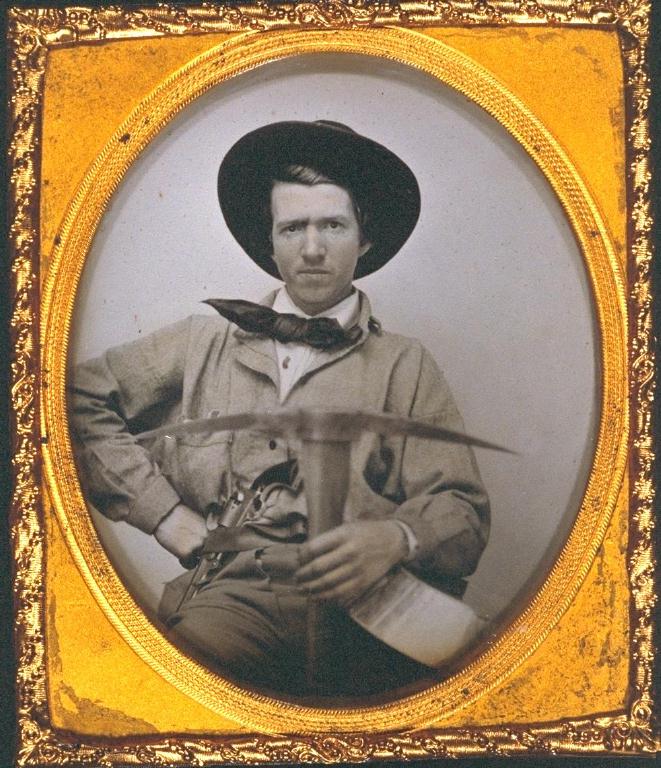
In another example from the 1850s, a man sits one hand on hip, holding his outer shirt open so that a gun is exposed. The other hand holds a pick axe. The portrait is labeled “Joseph Sharp of Sharp’s Flats,” most probably indicating that he would be overseeing a plot of land to be mined for gold. Since his clothing is clean, and the equipment looks new, the author surmises that the picture was taken soon after these items were purchased, dating the period at the beginning of the California Gold Rush. The manner in which the necktie has been pulled out is at one end is consistent with many pictures of men from the early 1850s. Taking into consideration these two elements - the beginning of the Gold Rush and the idiosyncratic necktie, Severa arrives at the date for the photograph as between 1850-1852.


source: Bancroft Library (hosted at Calisphere)

We look at these photographs, taken 150 years ago, and though the clothing is from another era, we are tied by the commonality of fashion, and the wish to keep a record of oneself. It is also gratifying that the author pays attention to our country's diversity including images of African Americans, Chinese immigrants and Native Americans are included here. Through her scholarship and knowledge we gain insight into the lives of these people. Her ability to read the photographs reveal details that might have been lost to us – one different detail on a dress that would’ve been dated earlier pulls the year that the photograph was taken into the next decade.
Severa sums up her outlook in her preface with an epigraph written by a woman portrayed in a photograph:

Look upon this face, and know
That I was a person, here, in this time and place,
And I was happy.

Dressed for the Photographer also includes a glossary, contacts for the photographic sources, an index, and an extensive bibliography.


Dressed for the Photographer: Ordinary Americans and Fashion, 1840-1900 by Joan L. Severa (Kent State University Press, 1995).

Wednesday, June 16, 2010

The Wearing of the Green – It’s Not Just for the Irish!

Memory Jacket designed by Linda Watson, Artist, Second hand Levi jacket with embellishments - on display in the Art, Music and Recreation Center, 4th floor, Main Library

"Going Green" is the hot new trend in the fashion world. The appearance on the runway of haute couture made from organic cotton, hemp and bamboo indicate that more designers are leaning toward an eco-conscious clothing industry. Closely related to this trend is a growing interest in upcycling, recycling and refashioning old clothes into new garments. Using worn-out clothes as raw materials offers a creative person the opportunity to experiment freely without having to worry about making mistakes with expensive yardage. A few yards of lace and some cleverly placed beads can transform a used pair of pants into expensive looking designer jeans.

Through its Green Stacks programming, the Library is committed to providing information on green living through its resources and its programs. One such event will take place on Saturday June 19 from 12:00 to 4:00 at the Main Library. A free class called Recycled Clothing: Creating New From Old will help participants create “new one-of-a-kind works of wearable art.” Call (415) 557-4400 for more information.

For those interested in this topic, but unable to attend the Saturday class, the Library has plenty of books filled with inspiring and innovative ways to refashion any wardrobe. A few are listed below:

Crafty Chica's Guide to Artful Sewing : Fabu-Low-Sew Projects for the Everyday Crafter by KathyCano-Murillo (Potter Craft, 2009).

Denim Revolution: Dozens of Ways to Turn Denim Cast-Offs into Fashion Must-Haves by Nancy Minsky (Potter Craft, 2008).

Embellished Fashions by Mickey Baskett (Sterling Pub., 2008).

Exquisite Embellishments for Your Clothes by Valerie Van Arsdale Shrader (Lark Books, 2006).

Jazzy Jeans by Mickey Baskett (Sterling Pub., 2006).

New From Old: How to Transform and Customize Your Clothes byJayne Emerson (Firefly Books, 2006).

Tuesday, April 6, 2010

Resources for Educators - Music, Architecture and Clothing / Fashion

The principals of the San Francisco Unified School District recently visited the San Francisco Public Library to learn about supplemental resources for classroom learning for grades kindergarten through high school.

We presented the following titles to the principals as ‘hooks’ for social studies and history classes based on the premise that students can be engaged by how others live –- from the music they listen to, the clothing they wear, to their homes and the world around them. For this reason, the titles are divided into the sections: Music, Architecture, and Clothing / Fashion.

Music

Alexander Street Press streaming music databases:

This resource includes “African American Song”; “American Song”; “Classical Music Library”; “Contemporary World Music”; and “Smithsonian Global Sound for Libraries.”

American Musical Traditions, edited by Jeff Todd Titon, Bob Carlin (Schirmer Reference, 2002). 5 volumes.

Includes volumes on Native American music, African American music, British Isles music, European American music, and a final volume on Latino American and Asian American music. In addition to chapters by folklorists, this set features material from the Smithsonian Institution’s Center for Folklife and Cultural Heritage. Each volume includes a bibliography, discography and a glossary.

Continuum Encyclopedia of Popular Music of the World, edited by John Shepherd et al. (Continuum, 2003-2005)

This set provides a look at popular music of every style in every region of the world.

Oxford Music Online database:

This resource contains the full text of the The New Grove Dictionary of Music and Musicians (29 volumes), edited by Stanley Sadie (Grove, 2001), The Oxford Dictionary of Music by Michael Kennedy (Oxford University Press, 2006), and The Oxford Companion to Music, edited by Alison Latham (Oxford University Press, 2002). This database covers terminology, individual musicians, genres, and music history by geographic region.


Architecture

Architecture of the California Missions by Kurt Baer (University of California Press, 1958).

Includes descriptive text plus black and white photographs.

California Missions: Measured Drawings by the Historic American Building Survey (Learning Windows Publications, 1999).

Consists of architectural drawings (often including ornamental detail) of all the California Missions.

Encyclopedia of Vernacular Architecture of the World, edited by Paul Oliver (Cambridge University Press, 1997). 3 volumes.

Explores how people construct, decorate and live in their homes. Volumes 2 and 3 are organized by geographic region.

The Greenwood Encyclopedia of Homes through American History, Thomas W. Paradis, general editor (Greenwood Press, 2008).

A chronological approach to U.S. domestic architecture.

History of World Architecture (New York : Electa/Rizzoli).

This 15 volumes series contains titles such as: Ancient Architecture; Pre-Columbian Architecture of Mesoamerica; Islamic Architecture; Renaissance Architecture.

The Seventy Wonders of the Ancient World: The Great Monuments and How They Were Built, edited by Chris Scarre (Thames & Hudson, 1999).

A survey of the ancient wonders of the world, “memorials of power” from ancient Egypt to Angkor Wat and the Great Wall of China.

The Seventy Wonders of the Modern World: 1500 Years of Extraordinary Feats of Engineering and Construction, edited by Neil Parkyn (Thames & Hudson, 2002).

Presents seventy great monumental works of architecture from around world since the sixth century.


Clothing / Fashion


Encyclopedia of Hair: A Cultural History by Victoria Sherrow. (Greenwood Press, 2006).

Covers hair in all its possibilities, from its history and customs to haircare, celebrity hair, tools and products for hair, and stylings.

Fashions of a Decade, series editor, Kathy Elgin (Chelsea House, 2007). 8 volumes.

Eight volumes covering western dress from the 1920s-1990s, including ties to popular culture such as film and music.

The Greenwood Encyclopedia of Clothing Through World History, edited by Jill Condra (Greenwood Press, 2008). 3 volumes.

A chronological and cultural survey of costume history.

The Worldwide History of Dress: With Over 1000 Illustrations, 900 in Color, by Patricia Rieff Anawalt (Thames & Hudson, 2007).

A visually-rich resource for non-western dress. Includes information on how spiritual and cultural practices, regional terrain and climate, and migration affect cultural dress.

Thursday, February 18, 2010

Alexander McQueen (1969-2010)


The provocative London fashion designer Alexander McQueen died on February 11, 2010. He was born in 1969 into a large working class family. At 16 he saw a television documentary on the craft of tailoring and the dearth of apprentices taking up the trade. This prompted him to drop out of school to work at the clothier Anderson & Sheppard. His education in traditional tailoring continued at two other houses - Gieves and Hawks and at the theatrical costumer, Berman and Nathan. He later worked for two other designers before returning to London to attend Central St. Martin’s School of Art. His final project there garnered a great deal of publicity. The collection was based on Jack the Ripper and Victorian prostitutes. Locks of human hair (which were sold by prostitutes for people to buy for their lovers) were stitched into blood red linings of the clothing.

Subsequent collections have been inspired by movies, 17th century anatomists, photography, historical events and a host of other sources. In a show entitled “Taxi Driver,” his first after graduating from art school, models wore heavy eyeliner and punk-type clothing accented with paint mimicking the color of dried blood. In the spirit of the show they also sneered at and flipped off the audience. One of the most memorable pieces to be introduced was the “bumster,” trousers that rode so low on the hips that they revealed cleavage.

In the “Highland Rape” collection the designer mixed the McQueen tartan with military jackets, and tailored jackets with torn lace dresses and skirts. The runway was transformed for the collection as well – McQueen placed heather and bracken on the runway, and the models staggered rather than stalked the catwalk. To claims of misogyny, the designer replied that he was referencing the uprooting of the Scottish in the 17th and 18th centuries by the English.

In 1997 McQueen took over the top spot at Givenchy, vacated by fellow Englishmen, John Galliano. The agreement allowed him to continue designing for his own label. In his first show for Givenchy he surprised the public by creating a collection that a reviewer in the London Guardian called “dangerously polite.” Over their 5 year association his designs for and remarks about the French couturier drew the ire of the old guard. In late 2000 Gucci bought a 51 per cent share in McQueen’s company, a rival of Givenchy. In March of the following year he gave his last show for Givenchy.


In his Paris collection, shown in October 2009, McQueen once again gave the audience a lot to talk about. Plato’s Atlantis opened with a blue –tinged video of a topless model lying with snakes, models wore a prosthetic piece around their eyes. But one of the most alien-looking of all these elements were the shoes dubbed “lobster claw” because of its apparent likeness to the crustacean.

In 2003 the Council of Fashion Designers of America named him International Designer of the Year. In the same year Britain awarded him a CBE, (Commander of the British Empire). McQueen will be remembered for the sensational nature of his collections and the theatricality of his shows; however without the skills that he built early in his career as a tailor, he could not have reached the level of success that he had achieved. There are no full length biographies available in the United States on Alexander McQueen, but the following materials are a starting point for research.


Current Biography Yearbook (H.W. Wilson Co.) 2002 edition. A substantial biography that also includes a bibliography.

Encyclopedia of Clothing and Fashion, Valerie Steele, editor in chief (Charles Scribner's Sons, 2005) - also available as an electronic resource through the Gale Virtual Reference Library (login with your library card number and PIN).

Contemporary Fashion [electronic resource], editor, Taryn Benbow-Pfalzgraf (St. James Press, 2002). Only available through the Gale Virtual Reference Library.

Extreme Beauty: The Body Transformed by Harold Koda. (Metropolitan Museum of Art; Yale University Press, 2001).

Fashion At The Edge: Spectacle, Modernity and Deathliness by Caroline Evans (Yale University Press, 2003).

Glamour: Fashion + Industrial Design + Architecture, edited by Joseph Rosa, Virginia Postrel, Valerie Steele and Phil Patton (San Francisco Museum of Modern Art in association with Yale University Press, 2004).

Skin + Bones: Parallel Practices in Fashion and Architecture, organized by Brooke Hodge (Museum of Contemporary Art [Los Angeles]; Thames & Hudson, 2006).

Monday, September 28, 2009

Kimono Display


In Japan, kimono is a generic word that literally means “thing to wear”. While this could cover a wide range of garments, it is usually used to describe the full-length robe that people associate with Japanese attire.

In earlier times, Japanese clothing closely resembled Chinese-style robes. “During the Nara period (AD 710-794), however, garments resembling the kimono began to appear, and after Japan suspended contact with China. . . a style began to emerge that became uniquely Japanese” (Jenni Dobson. Making Kimono and Japanese Clothing. London: Batsford, 2008).

Through October 19, the Art and Music Center will display a contemporary art style kimono designed by Northern California fiber artist Sharon Cahn. Colorful reproductions of book covers from books about kimono are displayed as well.


For further reading, the following books may be of interest:

The Book of Kimono by Norio Yamanaka. (Tokyo: Kodansha, 1986).

Fashioning Kimono by Reiko Mochinaga Brandon and others. (Milan: 5 Continents, 2005).

Kimono as Art by Itchiku Kubota. (London: Thames & Hudson, 2008).

Kimono: Fashioning Culture by Liza Crihfield Dalby. (New Haven: Yale Univ. Press, 1993).

Kimonos by Sophie Milenovich. (New York: Abrams, 2007).

Knit Kimono by Vicki Square. (Loveland, Colo.: Interweave Press, 2007).

When Art Became Fashion by Dale Carolyn Gluckman. (Calif.: Los Angeles County Museum of Art, 1992).

Thursday, April 2, 2009

Cut the Couture: I'll Do It Myself

"In these hard times — Dress Up! Do it yourself," proclaimed couture designer Vivienne Westwood in a hand-scrawled note reproduced for the 25th Anniversary of London’s Fashion Week. Included in the manifesto were her own unique suggestions, such as making clothes from “shawls, blankets, table cloths, curtains, towels, or a meter of beautiful fabric,” using “kerchiefs worn as knickers (good for disco or the beach) or tied up as a bag,” and to create a “necklace out of safety-pins.” While Westwood's statement was not entirely unexpected from a founder of punk rock fashion, it was either an excellent self-promotion stunt or an indicator of the cultural shift in favor of hand-making clothes over shopping.

The Art, Music and Recreation Center invites you take Dame Westwood’s challenge to heart and to ‘Cut the Couture.’ On exhibit in the Art, Music and Recreation Center’s wall case is a selection of D.I.Y. clothing books to instruct and inspire you. The projects presented range from ‘punk-rock’ and urban influenced designs (see books below), to ones encouraging material reuse and restructuring, to more artistic pursuits such as silk painting.

To view the exhibit or for the complete bibliography, please visit the library.

"Cut the Couture: I’ll Do It Myself" is an adjunct exhibition to House of Nat: Fashion Tips from the Schmulowitz Collection of Wit and Humor in the library's Skylight Gallery. It will be on display through the end of May.
Vivienne Westwood by Claire Wilcox. (London: V & A Publications, 2004).

Pretty in Punk: 25 Punk, Rock, And Goth Knitting Projects by Alyce Benevides and Jaqueline Milles; photographs by Rob Benevides. (San Francisco : Chronicle Books, 2007).

Subversive Seamster: Transform Thrift Store Threads Into Street Couture by Melissa Alvarado, Hope Meng, Melissa Rannels; photographs by Matthew Carden. (Newtown, CT: Taunton Press, 2007).

Punk Knits: 26 Hot New Designs For Anarchistic Souls And Independent Spirits by Share Ross; Photographs by Bam Ross. (New York: Stewart, Tabori & Chang, 2007).

Tuesday, January 6, 2009

20,000 Years of Fashion

An excellent source for a historical perspective of costume is 20,000 Years of Fashion by Francois Boucher. This book uses photographs of the art works of civilizations over the millennia to deduce what people through recorded history wore and why they wore it. The book is divided into large sections organized chronologically and by geographic region and then further into chapters by civilization. Within these chapters there are sections that describe the general conditions, geographical setting, trade, and adornments of that time and place.

For the earliest recorded costume, the book employs anthropological and archaeological resources to analzye ancient works of art. A statue of Idi-ilum, Governor of Lagash from the 3rd century BC shows great detail (shown above). The Sumerian shawl, a fashion staple of that time, is enriched by carefully knotted curled fringe – a level of detail that is astonishing considering the medium of its reproduction is stone.

As the centuries move forward into more recent history the sources available to study costume expand to include painting and writing. The chapters on Renaissance costume are full of portraiture showing styles of the day. The dress finery of the seventeenth century depicted in these paintings gives an indication of the wealth of the sitter, and also provides a challenge to the artist in depicting drapery and textures. Many paintings of impressionists will look familiar; Picasso and Matisse also depict fashions of the day, though these pieces may not be as well-known.

Photographs dominate the last pages. In a cluster of black and white photos from the twentieth century one shoe, with its heel placed forward over the arch is reminiscent of those of eighteenth century France, recycling the past into a new package.

Those interested in finding more titles on the subject of costume can browse the Dewey 391 call number in the library's circulating and reference collections. Other related areas to browse are the call numbers 646 (which includes works on sewing and clothing patterns), 746.92 (which includes works on fashion design and fashion designers) and 792.026 (stage costume).