Contemporary Composers (1992)
Tuesday, April 2, 2024
St. James Press Reference Dictionaries
Contemporary Composers (1992)
Sunday, August 21, 2022
The Fakebook Index
Do you know about the Fakebooks page on the Art, Music and Recreation Center home page?
It features a database for the Library's extensive collection of Fake books. The Harvard Dictionary of Music provides a snooty but fairly accurate definition of a fake book:
A collection of popular and jazz melodies with chord symbols (often rudimentary or simply incorrect) and sometimes words, used especially by musicians in restaurants, nightclubs, and the like as a basis from which to improvise or "fake" their own arrangements.
Faking often has a negative connotation implying a false or counterfeit action. Musicians from the jazz age onward viewed it positively. Faking meant the skill to be able to play by ear and improvise. Some created Fake Books as a guide, the fakebook being a collection of minimal arrangements usually just stripped down to the melody, chord changes and words.
A classic jazz combo often uses a melody as the "head" or introduction to their improvisation over the chord structure of the melody. Fake books played a role in enshrining certain melodies as "standards," often popular melodies or show tunes. (If you are interested in learning more, check out Ted Gioia's The Jazz Standards: A Guide to the Repertoire).
The earliest fake books were created without copyright clearance and did contain inaccuracies. By the 1970s music publishers were creating their own "legal" or "legitimate" fake books to meet musicians' demands.
Here are examples using the standard "I Get A Kick Out Of You."
The Book (an unauthorized fake book) opens with the chorus of the familiar Cole Porter tune. Chord names are circled and no words are given.
An "official" version of the song in the Just Standards Real Book (published by Warner Bros.) opens with the song's introduction (as sung in the show Anything Goes).
"I Get A Kick Out of You" takes up 5 pages in a songbook. The Just Standards Real Book presents it in 2 pages while in The Book it fills up only two thirds of a page.
Although both fake books present the song in the same key, a discerning musician will see small differences in the melody and the chord changes. These variations demonstrate why it's important to have a variety of fake books in our collection.
Fake books are in no way limited to jazz. There are folk, gospel, country, blues, Broadway, classical, and many other kinds of fake books. They are often used by musicians who busk, who play at receptions, in hotel lobbies, at restaurants or in any background capacity. And, of course, by any musicians who just want to "jam." They allow a musician to carry a great deal of notated musical information in a condensed form.
A standard fake book is considered to be in "C" – in non-transposed keys playable by "C" instruments like piano, guitar, violin and flute. There are also "Bb" fake books used by trumpet and tenor sax players, "Eb" fake books used by alto and baritone sax players, and bass clef fake books used by trombonists and string bass players.
Our Fakebook Index is built on an Access database where we include the title, the last name of the composer (often both songwriter and lyricist), and the title of the corresponding fakebook. It does not follow a keyword standard but instead searches for continuous strings of text of any length. You could look up the song above with "Porter" as a last name or with the full title or part of the title. You can also look up the name of a collection to view its contents.
We own reference copies of all of the fakebooks, but we also have circulating copies of many of them.
Fakebooks are often used by sophisticated musicians and sometimes sophisticated musicians have sophisticated needs. Please contact us in the Art, Music & Recreation Center if you need additional help.
Wednesday, July 20, 2022
The Etching and Engraving Picture File
The collection is vast, taking up nearly 100 linear feet of file cabinet space. Being hidden from view under lock and key, it requires a trip to 4th floor Art, Music and Recreation Center to partake of its riches.

There are folders for over 4,500 different subject headings. Some folders have only a single image while others have dozens.
There is good reason to believe that work on the Etching and Engraving Picture File was begun in the 1960s. It has undoubtedly been the work of many hands over many years.
Celeste West, librarian and editor of Synergy, the publication of BARC (the Bay Area Reference Center sponsored by SFPL), gave a very good description of this special collection in the February 1969 issue of the newsletter:
The vast picture collection now being classified and organized at SFPL is one of the most unusual to be housed in a public library. It will contain a million vintage illustrations obtained from 18th and 19th century books and periodicals. The collection is a fine resource in cultural history, providing pictorial information as well as examples of the distinctive art styles in vogue. Of special reference interest is the large section of portraits, which includes many copies noted in the ALA Portrait Index (1906). The picture file should delight historian, artist, and plain browser in its varied scope — everything from the intricate filigree of gothic engravings, through quack medicine ads, and even 1881 racetrack programs from England.[Author, publisher and librarian Celeste West, famed for her activism and as an editor of the book The Revolting Librarians, interspersed images from the collection through the issues of Synergy.]

As you can see from the newsletter cover above, the images in the collection were created using block print technology. From the beginning of the 19th century, lithography or prints using wooden blocks revolutionized commercial publishing. The Etching and Engraving Picture makes use of imagery from the popular illustrated magazines of that time along with individual prints and engravings.
With the advent and growing availability of photography images like these became thought of as old-fashioned and anachronistic. They did find favor among collage artists like the surrealist Max Ernst or in the “paste-ups” by San Francisco artist Jess.
One of the virtues of the images of this collection is that they are entirely copyright free. In his book Five Quarts: A Personal and Natural History of Blood, author Bill Hayes credits our Etching and Engraving Picture File for this image of Leonardo da Vinci. Since there is no legal reason to credit this public domain collection, there is no way of knowing how many other books we have helped to illustrate.

Left: Picture file reproduction in Five Quarts; Right: Image from the Picture file.
These images are also provide inspiration for visual artists. Children’s book illustrator K-Fai Steele credits this collection for inspiring the artwork in his book Okapi Tale, authored by Jacob Kramer. In an interview Steele noted that:
The cover is one of my favorite drawings from the book. When I was doing research for the visual world, in particular the Okapi’s factory, I started by looking at images from mills and mill towns in New England using the Etching and Engraving Picture File Collection at the San Francisco Public Library.

from the folder ”Mills and Mill-Work”
We have had patrons use images from the Etching and Engraving Picture to help them design restaurant menus or to provide inspiration for a tattoo. We treat the images like reference items requiring collateral ID while they are being used in the Library. While the Library does have excellent scanners for patrons to use, we do circulate individual images from our reference desk to library card holders.
Keep the Etching and Engraving Picture File in mind whenever you or a patron need artistic inspiration or if you want to take a little time to disappear down a visual rabbit hole.
Monday, July 9, 2018
Index to Art Periodicals
This publication is strictly a subject index. There are subject cards for people, artistic subjects, names of artworks, countries, cultures, cities and institutions. The index includes both fine arts and crafts.
I enjoy consulting indexes to see what kind of coverage they bring to our city, San Francisco. The image above shows three entries. The first two entries are from non-art publications -- Harper's and Life -- which would not surface in an art database search. The third publication is kept in storage at the Library. Photo-Era magazine of November 1923 has an article by Charlotte H. Mackintosh entitled "San Francisco, My City Beautiful" that shows photographs City scenes taken by members of the California Camera Club.
The top entry above indexes a photograph in Scribner's Magazine of February 1910. Searching the caption text in Google books brings a scan of the magazine and places the photograph within the context of an article by Henry T. Finck entitled "The Progressive Pacific Coast."
We can access the second publication -- Brush and Pencil -- through the JStor database. JStor is a fantastic resource, but this article would be very far down the lists of results in a search of this database. A search for the terms art earthquake san francisco 1906 in JStor pulls in over 1400 results, but "Details of the Art Loss in San Francisco" appears very far down in the search results.
The article from Horizon by Allan Temko, the long-time the long-time architecture critic for the San Francisco Chronicle. This article is a beautifully illustrated nearly 20 page color spread on the arts scene in San Francisco in the late 1950s in a general periodical.
When researching there is a danger of assuming that everything can be found on the internet or in databases. The information may be there, but it may not be readily accessed. Do not searching in older print indexes and bibliographis that provide other access points that can pull in fruitful results.
Thursday, April 12, 2018
The Literature of Rock - Hoffmann & Cooper
The researcher today has the internet and databases at hand to search for articles and information on all subjects. For the subject of rock music, the library subscribes to three very good databases.
The Music Index - article citations and full text for more recent coverage
Rock's Backpages - full text of articles by well-known rock critics and scholars, not thorough coverage
JStor - full text of articles in selective scholarly periodicals
Between these three resources and a good web search, a large amount of information can be found. But at times the amount of information is too great and it becomes difficult to choose and evaluate sources. This is where a good print bibliography can help out.
The Literature of Rock, compiled first by Frank Hoffmann and later together with B. Lee Cooper (with assistance from Lee Ann Cooper), was published between 1981 and 1995. The three volumes cover articles written respectively between 1954 to 1978, 1979 to 1983, and 1984 to 1990. The final volume also includes "additional material for the period 1954-1983".
Each volume has an index that lists the artists, bands, films, and subjects covered. This book is organized in a unique way that progresses chronologically and stylistically through the genre, thus grouping together music scenes and related artists.
Where the book shines is in the annotations that accompany each citation. This can give the researcher a sense of how useful an article will be for one's purposes. In addition to indexing articles, the Literature of Rock also includes book chapters and encyclopedia entries. The section for "Protest Songs" lists articles from mainstream publications like Life, Public Opinion Quarterly and Saturday Review, as well as sections from books. Because each volume adds new entries it can be necessary to consult each of the three volumes.
Anyone researching rock music, both its genres and artists, will discover valuable information. Of course, a bibliography like this is only the first step. Researchers then need to search the Library's online catalog to see whether the Library has the publications (in print or online). Sometimes knowing the citation information makes the article more easily found through an online search engine. When we do not own a book or magazine title, we can usually obtain it for our patrons through Inter-Library Loan.
The Literature of Rock by Frank Hoffmann (and B. Lee Cooper) (Scarecrow Press, 1981-1995).
Wednesday, January 25, 2017
art-SITES san francisco
The clearest answer to the question is when the information in it is no longer accurate or is superseded, and more critically, if the inaccuracies in the reference could lead to misinformation or harm.
Often travel guides fall into this category -- hotels, restaurants or attractions may open or close, the prices for attractions and accomodations may have changed. Yet for the locale written about, obsolete travel guides provide a historic perspective and may even reveal unseen features of a place to the reader.
In San Francisco we are fortunate to have many guides for those interested in the arts. Even some of the oldest ones remain important, if for no other reason, than they show the persistence of objects, buildings, and institutions over time.
art-SITES: san francisco: The Indispensible Guide to Contemporary Art-Architecture-Design was published almost 15 years ago. Obviously there have been many changes to the San Francisco Bay Area's cultural landscape over that decade and a half. Nevertheless, this reference book still opens up locations for artistic exploration that might escape the attention of many of us.
Organized geographically, San Francisco itself takes up about 70 percent of the book's pages. And those pages are devoted to the usual districts and neighborhoods -- Union Square, Civic Center, SOMA, the Financial District, Pacific Heights / The Presidio and Golden Gate Park. However, this is one of the few books to look at any of the site-specific art work at the San Francisco International Airport. It also includes the public art in and around the, then newly constructed, Yerba Buena Center for the Arts. Even more helpfully, it details some of the artwork concealed to many of us in hotels and office buildings.
Many of the Geary Street art galleries are listed and described, detailing the artists they represented. Of course, in the intervening years many of these art galleries have succumbed to market forces and had to close or to move to lower rent districts. art-SITES: San Francisco does capture that moment for those of us who want to remember that scene. Imagine the value of this information for someone creating a novel or a film about San Francisco in the 1990s?
Another way this book works as a time capsule is by documenting some of the street art of that moment. The Luggage Store Gallery gets a nod along with two works of art by a pair of Mission School painters who exhibited there - the husband and wife team of Barry McGee and, our late San Francisco Public Library colleague, Margaret Kilgallen. Both of these art-works were painted on the building's roll-down security doors at 1007 Market Street.
"Untitled" by Margaret Kilgallen
"Untitled" by Barry McGee
Both of these works are still documented on the Luggage Store Gallery's webpage. But a book like this tells us when the works were there and what they meant at that time. Google Street View only came later and gives us a different view:
1007 Market Street captured in Google Street View February 2014
art-SITES san francisco also has short chapters on the South Bay, the East Bay, Marin County and Napa and Sonoma Counties. In the chapter on the South Bay I came across art and architecture at Stanford that I was unaware. On the campus there works of sculpture by Mark Di Suvero, Andy Goldsworthy and Maya Lin. Additionally I learned about two university buildings designed by James Ingo Freed, the architect for the San Francisco Public Library's Main Library.
This reference opens with a directory of entry types -- museums, exhibition and performance spaces, galleries, public art, film centers, architecture, architects, urban planning, parks, gardens, plazas, design and bookstores. It concludes with an index of people, buildings and places.
art-SITES san francisco remains a valuable resource for anyone interested in understanding and exploring the culture of the San Francisco Bay Area.
Tuesday, September 13, 2016
Facts Behind The Songs
Facts Behind the Songs by Marvin E. Paymer is an idiosyncratic reference book for popular music. Its scope is the music from the 1890s (the earliest days of Tin Pan Alley) to the early 1990s. The books consists of alphabetical succession of articles by 11 contributors that are classified into 8 categories: 1) origin; 2) foreign influence; 3) domestic influence; 4) dissemination; 5) historical survey; 6) genre; 7) song subject; and 8) style of music and lyrics.
"Origin" brings together articles relating to the creators and the production of music. Some articles are about locales, others are about venues for creation.
"Foreign Influence" looks at the contribution of other cultures in American popular music. Domestic Influence likewise considers how American genres (ranging from Bebop to Zydeco) entered the musical mainstream.
"Dissemination" looks at technology and the institutions that offer music. The "Historical Survey" devotes a chapters to a variety of time periods; genre lists articles on a variety of styles of music.
Perhaps the most useful category is "Song Subject." There are articles about more than 100 categories ranging from "age" ("Forever Young," "My Generation") to "writing" ("Take a Letter, Maria," "Paperback Writer"). I have found this book to be helpful for the article "Classics" which includes a table called "The Classics and Popular Song." This provides a convenient listing of classical melodies that have become popular songs.
The book closes with a "Catalogue of Songs" that lists every song mentioned in the book giving the year it was written and the names of the songwriters. It also indexes every article where each song is mentioned.
The information in Facts Behind The Songs is mostly covered in other reference sources. The value of the book is the unique organization of this information.
Facts Behind the Songs: A Handbook of American Popular Music From the Nineties to the '90s, Marvin E. Paymer, general editor (Garland Pub., 1993).
Sunday, July 24, 2016
Handbook of Instrumentation
Orchestration and instrumentation are two inter-related musical skills. Orchestration is the art of combining and balancing instruments and voices in ensembles large and small. Instrumentation concerns the capabilities of the individual music components that make up these ensembles.
Andrew Stiller's Handbook of Instrumentation is an outstanding reference book on this subject. In this handbook he covers all the instruments employed today in the major instrumental families (woodwinds, brass, percussion, strings and keyboards). He also devotes space to the voice, electronics and to early music instruments.
His introduction as well as passages throughout the book are devoted to the physics and acoustics of these musical forces. He often explains how sound is generated by each instrumentalist. One particularly enlightening passage is his discussion of the voice, where he addresses the various registers and timbres and the acoustic properties of vowels.
A discussion of a given instrument will typically detail the entire instrument family. For instance, he provides illustrations and explanation for seven members of the clarinet family (the Ab, Eb, Bb, alto, bass, contra-alto and contrabass clarinets). For each member he provides its written range, an understanding of how loudly and softly it can be played, an explanation of its transposition. He also gives a sense of the instruments availability - the Bb clarinet is ubiquitous, the bass clarinet is common and the Ab clarinet is rare.
The section on percussion contains a very wide array from instruments -- from those of a classical orchestra, to the trap set, Latin percussion and mallet percussion. He also describes the effect of the various sticks and mallets used on these instruments.
Every section has gives the instrument's "performance characteristics," fingering and trill charts and related tools, techniques or specialized notation. At the end of the discussion of every instrument there are also musical examples that highlight the instrument.
The information in this book is aimed primarily at the student or professional composer or arranger. It also serves as a handy reference for instrumentalists (and librarians) because of the fingering and trill charts included for every instrument.
Sunday, March 1, 2015
Oriental Carpet Design
The reference book Oriental Carpet Design: a guide to Traditional Motifs, Patterns and Symbols gives a thorough introduction to all aspects of these rugs. This first section discusses the structure, colors, knots, dyes, origins of carpet design. The following sections discuss the elements of design: the border, designs that are universal, geometric and floral. Within these sections are chapter on motifs such as the boteh, and further descriptions of the geometric design. The format is somewhat of an anomaly, since the town or city where a rug is woven is often the most important factor in its design and construction - most titles in the collection divide chapters into geographical regions.
Books on this subject can be found in two different call number areas. Formerly these books were given the call number 745.2 (as part of industrial design). More recent books have a textile arts, 746.7, call number. Here are a selection of titles from our collection:
Antique oriental rugs and carpets by Philip Bamborough (Blandford Press, 1979).
Beginner's guide to oriental rugs by Linda Kline (Ross Books, 1980).
Complete illustrated rugs & carpets of the world edited by Ian Bennett (A & W Publishers, 1977).
Oriental rugs and carpets today by Georges Izmidlian (Hippocrene Books, 1977).
The splendor of antique rugs and tapestries by Parviz Nemati (Rizzoli; PDN Communications: Distributed by St. Martin's Press, 2001).
The story of carpets by Essie Sakhai (Moyer Bell, 1997).
The carpet: origins, art and history by Enza Milanesi (Firefly Books, 1999).
Heaven in a carpet (Institut du Monde Arabe; Calouste Gulbenkian Foundation, c2004).
Carpets from Islamic lands by Friedrich Spuhler (Thames & Hudson, 2012).
Thursday, September 4, 2014
Music Research Tools Free & Online through San Francisco Public Library
Your San Francisco Public Library card allows you to check out and return books to and from the Main Library and 27 branch libraries throughout the City. You can reserve material and have it sent to and any of these locations. It is also possible to request material from other libraries in California and from all across the country. Your Library card also gives you access to eBooks, eReference resources, databases and streaming audio and video.
Our collection includes more than 20,000 books, 32,000 scores, as well as the collected works of over 200 composers. We also have an in-depth collection of popular music and Broadway songbooks. The Dorothy Starr Collection contains over 38,000 pieces of vocal sheet music. Our collection also includes reference works, thematic catalogs, guides to repertoire, and resources for writing program notes. We have scores and instructional material for all instruments and ensembles.
CATALOGS AND BORROWING MATERIALS
The San Francisco Public Library Catalog. Our books, scores and recordings are indexed here. You can limit your catalog search to scores, books, eBooks, CDs, eMusic, DVDs, eVideos, or LPs.Link+. This is a service that allows San Francisco Public Library card holders to borrow material from other libraries in California and Nevada including many libraries from the CSU system.
Interlibrary Loan. San Francisco Public Library card holders can also request books and scores from public and university libraries from the entire country.
MUSICAL SCORE REFERENCE TOOLS
Classical Scores Library. Includes digitized scores, mostly of contemporary classical works not yet in the public domain.Dorothy Starr Sheet Music Collection. A collection of vocal sheet music. This collection is particular strong for popular song, but also includes Broadway and film song, art song, operatic arias (in various ranges) and choral works for various ensembles.
Fakebook Index. An index to lead sheets and fakebook arrangements for all styles of music including jazz, pop, rock, classical and folk music.
Orchestral Music Sets. The Library loans sets of parts to orchestral works to registered ensembles. These parts are also available to consult for audition preparation.
RESEARCH DATABASES
Oxford Music Online. Provides online access to the the New Grove Dictionary of Music and Musicians, The Oxford Dictionary of Music, The Oxford Companion to Music and the Encyclopedia of Popular Music.Music Index. A Comprehensive Guide to Music Periodicals and Literature. An index, abstracts and some full text to music periodicals.
Rock’s Back Pages. An archive 25,000 articles covering rock music’s movements and musicians.
JStor. Full text articles from 1838 onward from scholarly journals in all areas of the arts and humanities.
African American Music Reference. Essays and images that document all forms of black American musical expression, including blues, jazz, spirituals, civil rights songs, slave songs, minstrelsy, rhythm and blues, gospel.
STREAMING AUDIO AND VIDEO from Alexander Street Press
Classical Music Library. High quality streaming audio to more than 15,000 classical music albums covering all eras and genres.American Song. A streaming audio collection of over half a million tracks of American roots music and pre-1960 American popular music.
Contemporary World Music. Provides access to more than a million tracks of music from 169 countries in contemporary and traditional styles.
Smithsonian Global Sound for Libraries. Provides audio and liner notes for recordings from the Smithsonian Folkways label. These include world music, folk music, classical music and spoken word recordings.
Classical Music in Video. Contains more than 1,000 hours of classical music performances and masterclasses in streaming video.
If you have questions or need reference assistance, call us at 415-557-4525 during regular Library hours.
Monday, May 19, 2014
Clothing, Dress, Fashion, Costume. Where Do You Start Your Research?
When you begin your research, just browsing the right shelf area is often more effective than an online catalog search. If you’re not exactly sure what you need, an excellent place to start is the Art, Music and Reference Center room reference section, Dewey number 391.003 on the fourth floor, row 55. This is the call number for dictionaries and encyclopedias of costume. Among other general clothing reference works we have three outstanding sets of encyclopedias. Each set has a different way of organizing information and a slightly different focus:
Encyclopedia of Clothing and Fashion, (in 3 volumes) Valerie Steele, editor in chief (Charles Scribner's Sons, 2005). Also available online with your San Francisco Public Library library card through the Gale Virtual Reference Library.
This is a broad-based encyclopedia with a straightforward alphabetical format. It provides an in-depth survey of clothing and body adornment. It also examines the origins of clothing, the development of fabrics and technologies, and the social meanings of dress.
This encyclopedia presents information on representative costumes from a wide variety of historical eras. Topics range from the bustle, sari, and toga to Polyester and body piercing, the cocktail dress, bathing suit, burqua, and the Nehru jacket. There are also entries for techniques and manufactures such batik, dry cleaning, zipper, stone washing, for body adornment such as makeup, masks, tattooing, and wigs, as well as for important persons and institutions like Coco Chanel, Edith Head, Yves Saint-Laurent, and Fashion Institute of Technology.
The longer essays provide a wider cultural context: class, gender, sumptuary laws, costume design for stage and screen, advertising, fashion careers, ecclesiastical dress, etc. It includes a comprehensive general index in the last volume, as well as a timeline, and a topical outline.
The editor in chief, Valerie Steele, is chief curator and director of The Museum at the Fashion Institute of Technology. She is a widely respected authority on fashion and clothing history. We have many books written or edited by her and they are all well-researched, well-written and useful for the casual or serious researcher.
Some of the strengths of this set are the easy to search A to Z format and the inclusion of a bibliography for each entry, both for sources and further research. This is also the only one of the three sets that includes contemporary fashion subjects. For example, a four page article on crowns and tiaras describes new tiara trends started by Vivienne Westwood and Gianni Versace.
The index at the end of the third volume is superlative. In addition to the conventional uses of an index, a quick browse through this could give you new directions for your research. The outline at the end of the same volume is divided into seven broad subject areas and then subsequent categories within each topic. Since the encyclopedia entries are in A to Z format, the outline is helpful in finding related articles. If you need help in structuring a report, this outline will help as well.
Encyclopedia of National Dress: Traditional Clothing Around the World (in 2 volumes), Jill Condra, editor (ABC-CLIO, c2013).
This set has entries for 130 nations or autonomous regions listed alphabetically. It examines clothing in the context of the cultural identity of people who live in regions all over the world, providing a historical and geographic perspective that illustrates how people dress and explains the reasons behind the material, design, and style. Each entry in the encyclopedia includes a short historical and geographical background for the topic before discussing the clothing of people in that country or region of the world. This work will be of great interest to students researching fashion, fashion history, or history as well as to general readers interested in anthropology, textiles, fashion, ethnology, history, or ethnic dress.
This resource has many strengths. Each entry has a list of “Further Reading and Resources” list at the end citing both print and online sources for more in-depth research. The information is detailed, but still appropriate for middle school through undergraduate level searchers. Each entry begins with the historical, geographical and environmental background, which is then tied in to how these affect the textiles used and the clothing worn. There is also an explanation of the difference between everyday and special-occasion dress. The rituals and special occasions important to each country are described.
At the end of the 2nd volume there is a list of museums with national dress and textile collections.
The 10-volume Encyclopedia of World Dress and Fashion, the most comprehensive reference work of the three, explores all aspects of dress and fashion globally - from pre-history to the present day. Arranged geographically, the first 9 volumes each cover a region of the world. Volume 10 is on global perspectives. This work is written by an international team of experts, and is the most in-depth source for all issues relating the art and anthropology of costume, dress, and fashion for students, scholars, members of the design and fashion industries, and fashion aficionados. All articles have been specially commissioned from over 600 renowned scholars from every part of the globe. Particular effort has been made to commission articles by indigenous scholars with in-depth local knowledge.
This set also has many strengths. It is the most scholarly of the three encyclopedias and is recommended for the serious researcher. Each volume begins with general regional view, but then drills down to an exceptionally detailed view of each country. This work provides the sometimes hard-to-find information on contemporary design, trade and present day influences of dress for all regions of the world. The Contributors are extremely knowledgeable about the technical aspects of textiles and clothing construction. Many disparate elements such as religion, colonialism, natural resources, the significance of iconic garments and the importance of key colors are explained in relation to each other and create a deeper understanding of the culture. Volume has unique and thought-provoking essays on global perspectives. It addresses world influences and trends. There is also a timeline and a cumulative index.
Thursday, October 10, 2013
Animals on Screen and Radio
Reference books are the answer. A well-indexed reference book can bring together information on a topic in helpful and sometimes unexpected ways.
Animals on Screen and Radio is just such a reference book. It is an annotated listing of 1373 theatrical and television films, 114 television series, 26 radio series. While not all of these films have animals as their principal theme, the annotations look into the role of an animal or animals within the film.
The most useful feature of this reference are the two indexes - a subject index and name index. The name index is a listing of an animal character's or an animal actor's name. Who knew that the name Freddie could refer to a lion (in the Daktari TV series), a seal (in the Galloping Fish), or an animated frog (in Freddie as F.R.O. 7)?
It is the subject index that is most helpful. It is both an index by animal species and by theme or subject. In addition to the standard menagerie of the domestic and wild kingdoms, there are unexpected categories like Bacteria and Viruses, broader categories (Talking Animals, Show Animals), and supernatural categories (Aliens, Ghosts).
The themes and subjects included in the index provide a unique approach to this topic. A very wide range of subjects are covered. Just touching the surface there are listings for Adoptions, Advertising, Aging, Animal Rights, Children, Courtships, Cruelty, Devotion, Friendship, Gangs, etc...
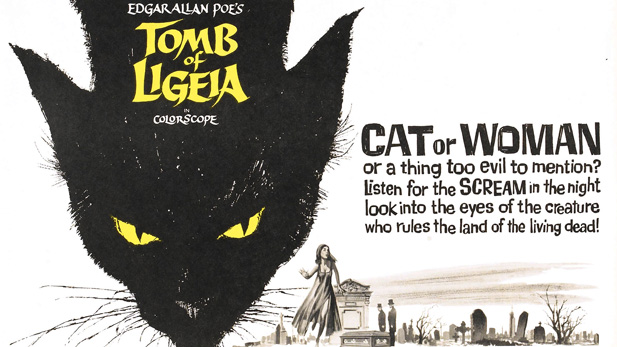
Under the heading of "Reincarnation" we find Tale of Ligeia - a Roger Corman directed film of an Edgar Allan Poe short story, starring Vincent Price. In this film a cat is possessed by a dead woman's vengeful spirit.

image source: Arizona Public Media website
In the category of "Tramps" we find the movie Down and Out In Beverly Hills where Nick Nolte's character befriends a dog.
image source: Cineplex.com
Animals and Screen and Radio promotes a broad understanding of the depiction of animals in films from the early silent days up through the 1980s. This book is useful both for the film buff and for the animal lover, introducing them to new themes and situations highlighting our animal companions and the natural world. Nowadays through recordings, television, and the internet, a vast range of film is available to us all. A serendipitous browse through the index and listings of this work could introduce the reader to entertaining and maybe previously unknown or forgotten films.
Animals on Screen and Radio: An Annotated Sourcebook by Ann C. Paietta and Jean L. Kauppila (Scarecrow Press, 1994).
Tuesday, June 11, 2013
Animated TV Specials: The Complete Directory to the First Twenty-Five Years
a still from It's the Great Pumpkin Charlie Brown, from the ABC website
It's easy to assume nowadays that all of one's information needs can be met through the internet and other online resources. In the areas of film and television two resources, the Internet Movie Database and The Wikipedia, have made mountains of information available to fans and researchers -- information that was once very difficult to locate. However, there are still reference books that provide detail and context not yet available through online sources.
Animated TV Specials by George W. Woolery from 1989 is an encyclopedia of American broadcast TV specials from 1962 to 1987, a period of time that could, in retrospect, be viewed as a sort of golden age of the form.
He traces the origin of this type of programming to the December 18, 1962 broadcast of Mr. Magoo's Christmas Carol. Later animated TV specials that have made a lasting mark on American popular culture include Rudolph, the Red Nose Reindeer (broadcast December 6, 1964) and A Charlie Brown Christmas (broadcast December 9, 1965). The former generated two sequels, while the latter had generated 31 sequels through the beginning of 1987.
This reference book covers 434 titles, providing a summary of each program. It also details the date of the broadcast premiere, the broadcast time, network, and the sponsor. Additionally there is information about repeat broadcasts, and later syndication. Finally the producers, directors, music and lyrics creators, company and distributors are also given. There are also excellent credits for characters and voice actors. In a few cases I found more detailed credits in this reference than were given in online sources.
The appendix includes a compilation of the most frequently aired animated specials (through 1986-7). There is also a listing of animated TV specials using stop-motion animation, a listing of holiday and topical animated TV specials, and a list of specials by series.
Very importantly for a reference book there are also indexes of producers, directors, and filmmakers, writers, musicians and lyricists, and voice actors.
There is one listing for the composer and music producer Quincy Jones. He created the music for an animated special by the important husband and wife team of John and Faith Hubley entitled Dig. Woolery describes Dig as a "fantasy trip through the layers of the earth and millions of years of history."
Jones' music alternates between cool jazz, electronic sounds and songs sung by his musical associates like Harry "Sweets" Edison, Don Elliott, and Ruth Price.
Famed soundtrack composer Danny Elfman has one listing in this book. Family Dog appears to be the only animated program in Stephen Spielberg's Amazing Stories series. This program was directed by Brad Bird. Stan Freberg and Mercedes McCambridge are the principle voice actors.
There appears to have only ever been one Doonesbury animated film -- unsurprisingly entitled A Doonesbury Special.
This appears to be the only instance of voices being attached to the familiar characters of the long-running comic strip. Woolery's book provides complete credits and a summary of the show (not available through the Internet Movie Database).
It used to be very difficult to see the majority of these programs. But with the advent of the hundreds of available cable and satellite channels and on demand viewing through the worldwide web, many of these programs are today very readily viewable. It's fascinating to skim this book and search for these films online.
Animated TV Specials: The Complete Directory to the First Twenty-Five Years, 1962-1987 by George W. Woolery (Scarecrow Press, 1989).
Monday, October 29, 2012
The Encyclopedia of Dead Rock Stars
Reading List:
The Rock and Roll Book of the Dead: The Fatal Journeysof Rock's Seven Immortals by David Comfort (Citadel Press, 2009).
Sunday, October 14, 2012
Musicals!: A Complete Selection Guide for Local Productions
Musicals! gives bibliographic information about any published libretto (or script), condensations of the libretto, piano-vocal score, and when there is no piano-vocal score, whether there are vocal selections.
This is extraordinarily helpful information because in many cases, libretti and scores have not been commercially published. Patrons are sometimes confused to learn that there is no published score or script for the music they seek. But there is a logical reason for this--the rights holder of the work has made a decision that it is in their interest to make the scores and scripts available only on a rental basis. Thus, Musicals! also includes another crucial bit of information - the Licensing Agent who owns the rights to each show. They are also the ones who rent out performing material like scripts, performing scores and parts for the musicians in the pit.
Musicals! also gives information about commercially-released cast recordings (when they exist). Finally, it also provides information about the numbers of actors and actresses needed to perform the work and a listing of songs from each show.
This resource also includes four indexes. The first two provide contact information for the Licensing Agents and Publishers cited in the book. There is also an index of composers, lyricists and librettists. The final index is also very important - a song index to all of the numbers in each show included in the reference.
A copy of the 1984 edition of Musicals! is available to view online through archive.org for library users who register with Open Library.
Musicals!: A Complete Selection Guide For Local Productions by Richard Chigley Lynch, 2nd edition (American Library Association, 1994).
Thursday, September 20, 2012
What is the Red Book? What is the Blue Book?
Despite their different colors, these books are maddeningly similar. They share the same author, same editor and same publisher. They both provide pricing information for United States coins according to year, denomination and mint. So the question is, which of these references sources should you use and when?
The introduction to the Guide Book (Red Book) states that its aim is to give "retail prices figured data from the listed contributors approximately two months prior to publication." In other words, the prices in this source are a composite of the prices at which dealers have been selling their coins. It also describes the reasons why a coin's price might fluctuate.
The front and back covers of the Handbook (Blue Book) boasts that it is the "#1 best-selling book on dealer coin prices." The introduction of this volume reads: "The values shown are representative prices paid by dealers for various United States coins." It also notes that "[o]n some issues slight differences in price among dealers may result from proximity to the various mints or heavily populated centers."
The most important single factor in determining the price of a coin is its condition. Top price is always paid for uncirculated, unblemished coins. These books both detail the varying degrees of condition of coins from About Good (AG-3) -- "very heavily worn" to "Perfect Uncirculated (MS-70) -- the "finest quality possible."
So, to sum up: the Guide Book (Red Book) is the approximate price that the coin dealer will sell the coin to you for; the Handbook (Blue Book) is the approximate price that the coin dealer will buy the coin from you for. Naturally the former price is higher. A dealer will sell a proof (PF-65) 1996 quarter from the San Francisco mint for $5.00, but will buy it from you for $1.75. Thus it pays to look at both books to understand how to get the best price for your coins.
We receive new editions of both of these books annually - our old copy of both of these books in 1953. Having a large range of years can help the collector understand the fluctuation of coin values over the years and also can help an appraiser understand the historic value of coins.
A Guide Book of United States Coins (Western Pub. Co., annual).
Handbook of United States Coins: With Premium List (Western Pub. Co., Whitman Hobby Division, annual)