Monday, June 18, 2007

Leo Lentelli: A Sculptor of the City Beautiful

Though Italian-American sculptor Leo Lentelli lived in San Francisco a relatively short time (from 1914 to 1918), he was an active participant in the artistic renewal taking place in the City at that time. As San Francisco rebuilt after the 1906 earthquake and fire, the City Beautiful movement was reaching its zenith. Noted architectural historian Banister Fletcher in A History of Architecture has written that proponents of the movement sought to “give form and direction to the rapid development of urban areas, to make them more efficient and more attractive areas.” In the new Dictionary of Architecture and Landscape Architecture, James Stevens Curl also notes that this beautification was part of a civic desire to “enhance prestige and attract wealth” for cities.


Lentelli's "Water Sprites" in the Court of Abundance at the Panama-Pacific International Exposition (Image from the Bancroft Library, through the Online Archive of California)

San Francisco’s Palace of Fine Arts and Civic Center are the two principal testaments to the influence of the City Beautiful Movement. The Exposition was a temporary city within the city that emulated the 1893 World’s Columbian Exposition in Chicago that gave birth to the entire City Beautiful movement. The Palace of Fine Arts is the sole remaining structure from the 1915 Panama-Pacific International Exposition. The Exposition grounds were one large indoor and outdoor art exhibition full of sculptures. Many structures also featured mural painting or inlayed sculpture. One of the striking features of art of this event in hindsight was its transitoriness. A. Stirling Calder (the father of Alexander Calder), the Exposition’s Chief of Sculpture, wrote that the sculpture of the Exposition “a passing matter. In a few years, interesting and beautiful as it is, it will be a memory ...”

"Aspiration" Above an Entrance to the Palace of Fine Arts (Image from the San Francisco Historical Photograph Collection)

Leo Lentelli, an assistant to Calder, was one of the contributors to this visual memory with sculptures that today we can view through the Library’s San Francisco Historical Photograph Collection and the Online Archive of California. He did a series of equestrian statues that were part of the Court of the Universe and his sculptures of Water Sprites for the Court of Abundance was well-received. His sculpture “Aspiration” then placed above the door to a gallery of the Palace of Fine Arts caused a stir because of its seemingly precarious position.

"Five Symbolic Figures" Above the Larkin Street Entrance to the Old Main Library (Photograph from the San Francisco Historical Photograph Collection)


The other major City Beautiful project that San Francisco undertook at this time was its Beaux-Arts style Civic Center. Lentelli created “Five Symbolic Figures,” a series of five statues representing Art, Literature, Philosophy, Science and Law, that were placed between the pillars above the entrance to the Old Main Library at Larkin Street. These works, made of cast stone (a cement-like substance) were installed in 1918, the year after the Library opened, and were not intended to be permanent. Sadakichi Hartmann, writing for the Architecture and Engineer in 1918, praised these works for “their sturdiness of conception and attitude, their decorative expression, and a certain swing and freedom of handling.” Unfortunately, by the time the Asian Art Museum renovated the Library these works had deteriorated so much that no attempt was made to retain or restore them.

Perhaps Lentelli’s most significant contribution to San Francisco was to the design of the "Path of Gold" Light Standards that line Market Street from the Ferry Building to Castro Street. The conception of these standards originated with Willis Polk, the sculpture at the base of the lights was created by Arthur Putnam. Lentelli was responsible for the design of the lighting itself.

"Two Decorative Figures" at the Mission Branch Library, 24th Street and Bartlett

There are still a few examples of Lentelli’s work in San Francisco. Visitors to the Mission Branch of the Library will recognize the “Two Decorative Figures” – an image of a boy and a girl holding a book between them - above the 24th Street entrance. Additionally at 111 Post Street (originally the Hunter-Dulin Building) there is a figure of Mercury at the entrance as well as relief medallions representing “The Seasons.”

"Mercury" at 111 Sutter Street, San Francisco


Library Resources consulted:

Our department has a very helpful and extensive Vertical File that includes photocopies of several articles and documents about Lentelli. This file includes a copy of Sadakichi Hartmann’s article “An Expression of Decorative Sculpture – Leo Lentelli,” published in The Architect and Engineer volume 52, number 3 (March 1918).

On the sculpture of the Panama-Pacific International Exposition, see Sculpture of the Exposition Palaces and Courts; Descriptive Notes on the Art of the Statuary at the Panama-Pacific International Exposition, San Francisco by Juliet James, and The City of Domes; a Walk With an Architect about the Courts and Palaces of the Panama-Pacific International Exposition by John D. Barry. The A. Stirling Calder quote may be found in “Fine Arts at the Exposition,” the Transactions of the Commonwealth Club of California (Nov. 1915).

The Historic Structure Report, Old Main Library created by Page & Turnbull for the San Francisco Planning Dept. and the Asian Art Museum provides the most detailed information about Lentelli’s “Five Symbolic Figures.”

For the Market Street Light Standards see Splendid Survivors: San Francisco's Downtown Architectural Heritage by Michael R. Corbett. Information about Lentelli’s other public art can be found in A Survey of Art Work in the City and County of San Francisco prepared by Martin Snipper for the Art Commission, City and County of San Francisco.

A footnote:

Some research in the library’s New York Times Historical Database led to the discovery that Lentelli created the sculpted lunette above the entrance to Steinway Hall in New York City at 111 West 57th Street. A December 9, 1990 article describes how this work had been covered by the Manhattan Life company in 1958 and later revealed and restored by new owners in 1990. (Search the database using the terms “lentelli” and “steinway”).

Sunday, June 3, 2007

A Musical June at the San Francisco Public Library

This month the Library will present a series of three wide-ranging concerts in the Main Library's Koret Auditorium.


On Tuesday, June 5, 2007 at 6:00 p.m., the San Francisco-based Del Sol String Quartet will be here to present “Umbilical Chords - Women Composers and the Creative Process,” a concert of music by Linda Catlin Smith (USA), Ruth Crawford Seeger (USA), Teresa Carreno (Venezuela), Sally Beamish (Great Britain), and Kui Dong (China). This program focuses on how motherhood has shaped the creative process for each of these composers.


On Sunday, June 10, 2007 at 2:00 p.m., the Six Golden Flowers Ensemble will give a performance. This is a group of six young women from the Bay Area who perform on the guzheng, a traditional Chinese instrument. This concert, co-presented by the San Francisco Gu-zheng Music Society will feature classic pieces like The Evening Song of the Fishermen, and modern works like Battling the Typhoon and Dance of Yi.


On Saturday, June 16, 2007 at 2:00 p.m., the library will present a program entitled "Now We Can Sing." Flutist Barbara Siesel and actor/storyteller Keith Torgan will present music that was banned to Jewish musicians by the Nazis in 1930s Germany. They will re-create the times through music by Bach, Schumann, Hindemith, Copland and Gershwin as well as cabaret songs by Frederich Hollaender.


These programs are supported by the Friends of the San Francisco Public Library. All programs at the San Francisco Public Library are free. The Koret Auditorium is located in the Lower Level of the Main Library, at 100 Larkin Street (at Grove). Call (415) 557-4277 for more information.

Thursday, May 31, 2007

A New Bay Area Architecture Title

Architecture lovers should check out Architecture of the San Francisco Bay Area: History and Guide, a new survey of Bay Area architecture by local author Mitchell Schwarzer (Professor of Art and Architectural History at California College of the Arts)

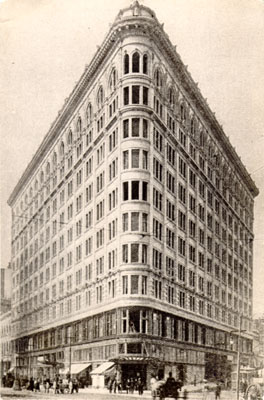
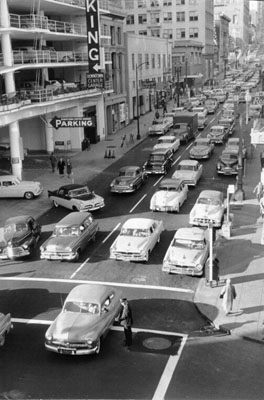
Dubbed an “evolved successor” to Architecture and Design: SF, a small traveler's companion published in 1998, this guidebook covers both classic and contemporary architecture of the Bay Area with the author’s unique and unvarnished perspective. His coverage ranges from the sublime – the Phelan Building “could stand-in for the white city that San Francisco was becoming during the City Beautiful Era – to the ridiculous and sublime – the spiral ramp of the Downtown Center Garage designed by George Applegarth “adds enough movement to take the composition from simplicity to sublimity.”

His take on the San Francisco Public Library’s Main Library? Schwarzer remarks that architect James Ingo Freed “compresses and changes the Beaux-Arts classical language of its neighbors” in the Civic Center. He regrets, however, that the building fails “to cohere into a greater whole.” (Please do come and see our building anyhow).

Such is a sampling of Schwarzer’s terse informational gems, which dot his tour of this man-made landscape we call home. A history of the Bay Area and easy to read maps are also included in this colorful pocket tome published by esteemed local publishing house William Stout Publishers.

Thursday, May 24, 2007

"Dude" Martin Songbooks

Recently the library has received gifts of two songbooks by Bay Area country music performer and broadcast celebrity Dude Martin. Born John Steven McSwain on a farm in Plainsburg, Merced County, California on March 21, 1915, Dude Martin grew up in Oakland and Berkeley. His first band, The Nevada Nite Herders, first appeared on KLX radio on April 15, 1932 (KLX was the predecessor at 910 AM to KNEW). One of our songbooks, Songs of the Nite-Herders, was published in Oakland by F. E. Cox and Staff in 1936. It consists entirely of Martin’s original compositions as well as photographs of the band, their radio studio, and of Dude Martin roping a steer. It also features a glossary of “cowboy lingo” and signatures of the band’s members.

By the mid-1930s, Martin’s show was known as the “Round-up” and was in syndication. Our other song collection, “Dude” Martin’s Folio of Original Songs of the Plains, was published in 1939 by American Music, Inc. in Portland Oregon. This songbook only includes a handful of Martin’s original songs like “Yodel Mountain” and the “Night Herder’s Lullaby.” It shows photos of his group, then called the Wild West Show Revue Gang, at the Columbia Studios in San Francisco and at the World’s Fair on Treasure Island. By this time Martin had moved to KYA in San Francisco at 1260 AM (today known as KOIT).


"Dude" Martin's Band with audience, photographed by Dorothea Lange (image from the Oakland Art Museum)


In the mid-1940s, during World War II, photographer Dorothea Lange took a series of photographs of Richmond, California, then bursting to the seams with newly arrived shipyard workers. This collection includes photographs of Martin entertaining the Richmond audience. This photographs are available to view from the Oakland Museum's collection at the Online Archive of California. Martin’s various bands performed music ranging from country music, cowboy songs to Western swing. Some of his band members, like Carolina Cotton, Sue Thompson and Rusty Draper, went onto to have successful careers on their own.

Martin was also a pioneer of Bay Area television, hosting a variety show in 1949-1950 called the Hoffman Hayride. His success – the Hayride was voted by San Francisco Examiner readers as their favorite television program – led to his move to the more lucrative Los Angeles market where he broadcast from KTTV. Martin died on February 11, 1991 in Orange California. Jim Goggin has written a book The Dude Martin Band Story that includes interviews with band members and is replete with photographs and newspaper clippings.


Wednesday, May 9, 2007

Printed Indexes for Film Reviews

In this time of search engines and databases it’s easy to forget that there are important reference books that have not yet been superceded by the internet. One important research tool is the Film Review Index. This two volume source indexes films from Muybridge’s earliest experiments in 1882 up through 1985. It includes citations for reviews in popular magazines like Time, Life, Newsweek, The New Yorker and Vanity Fair, as well as motion picture magazines like Sight and Sound and Photoplay. With these citations you can look up the actual magazine reviews in the library’s Magazines and Newspapers Center. But beyond the coverage of these periodicals, the Film Review Index also indexes other print sources like Magill’s Survey of Cinema, a number of film dictionaries, as well as books about film directors, actors and actresses that discuss a given film. Other helpful features of this set include an index of directors, as well as indexes for when and where a film was produced.

The Film Review Annual is another important reference tool. This work has been published annually since 1981 and includes full text film reviews from more than a dozen popular and scholarly film magazines. While it’s coverage is relatively limited, reprinting reviews of a few hundred films for each year, it provides an in-depth cross-section of critical opinion about each film. Each volume also includes a list of award winners as well as indexes for cast members, producers, directors, cinematographers, editors, composers and crew members.

Other excellent resources for film reviews include the New York Times Film Reviews (1913 to 2000) and Variety Film Reviews (1907-1996). These multi-volume sets reprint the complete film reviews of both these publications in chronological order. The Motion Picture Guide by Jay Robert Nash and Stanley Ralph Ross is also a useful source. This multi-volume set provides a detailed plot summary, production anecdotes, full credits (including music), and criticism of films through 1998.

As always, if you need help working with these tools, come and ask for assistance at the Art, Music and Recreation reference desk.

Wednesday, April 25, 2007

A New 10 Volume Encyclopedia of Popular Music

Colin Larkin’s Encylopedia of Popular Music is a welcome new addition to our department’s reference desk. This is the 4th edition of a reference book that was originally published as the Guiness Encyclopedia of Popular Music in 1992. The current edition is consists of 8.5 million words published in 10 volumes and includes thousands of entries about singers, songwriters, musical groups, producers, genres, styles, and record labels. In the entries for recording artists, the author has also included an album discography and rating for those albums.

Today many popular music fans have come to rely upon websites like the Wikipedia and Allmusic for information about their favorite bands and musicians. It’s a fair question to ask why they should go to the trouble of visiting the library to consult a weighty reference tome. One reason is that while both of those websites can be very good at covering the most recent popular music, their coverage of earlier time periods can be spotty and unreliable. Another reason is Encyclopedia of Popular Music has a consistent prose style and editorial tone – unlike the Wikipedia, a collectively written source whose entries lack a consistent format or style. Of course, web-based sites will continue to have the one important advantage that they are current and up-to-date.

One suspects that the creators of web articles consult a work like the Encyclopedia of Popular Music because of its size and thoroughness. The author has gone to pains to find birth and death dates and places of most artists. While the source is heavy on Anglo-American pop and rock it also includes many artists from the worlds of jazz, folk, blues and musical theater.

The author is from the United Kingdom and although he rejects the characterization of his work as anglophile, there is a British outlook to the work, not so much in its range of coverage as in its outlook and evaluation of musicians. Writing a favorable article about the San Francisco band American Music Club, he describes them as “one of their country’s most undervalued bands.” In an entry on the Bay Area rapper Paris he cites the artist’s political views, discusses the creation of several recordings and involvement with other recording artists. He also mentions the rapper’s work as a stockbroker (a detail not found in the Wikipedia article on him).

One can always quibble with the coverage of any reference work. For instance, why include one important Bay Area indy band Erase Errata yet omit Deerhoof, another well-known local band? Irregardless of any minor shortcomings, the Encyclopedia of Popular Music is a remarkable reference source that will reward its readers for many years to come.

Tuesday, April 17, 2007

National Dance Week Programs at the Library

In honor of National Dance Week, April 20th – 29th 2007, the Art, Music and Recreation Center of the San Francisco Public Library will sponsor two events. To find out about dance-related events happening citywide, please visit the website for Bay Area National Dance Week.

The first event is "Isadora Duncan, Mother of Modern Dance." It will be held on Saturday, April 21, 2007 from 2 to 3 PM at the Main Library's Koret Auditorium.

Lois Flood, dancer and choreographer, performs Duncan's choreography and Joanna Harris, author of the forthcoming book Beyond Isadora: Bay Area Dancing, 1915-65, offers commentary to present a snapshot of the 20th century's mother of dance invention and her groundbreaking work.

The second event entitled "Alicia" will be held on Tuesday, April 24, 2007 from 12 to 2 PM at the Koret Auditorium.

Dancer/choreographer Frank Boehm and a crew of independent filmmakers traveled to Cuba in the mid-1980s to make a documentary film about Alicia Alonso and the Cuban National Ballet. Like the film Ballets Russes, it reveals the personality behind the virtuosity of Cuban ballet and shows how folkloric dance and ballet are melded in a special mix, nurtured by Fernando Alonso's curriculum and Alicia Alonso's gift for pantomime and theatricality.

All Library programs are free. The Koret Auditorium is located in the Lower Level of the Main Library, 100 Larkin Street (at Grove).

This program is support by the Friends of the San Francisco Public Library.