Thursday, October 31, 2013

Merola Goes to the Movies: Otello

Otelloposter.jpg
source: Wikipedia

For our second program, the Merola Opera Program and the San Francisco Public Library continue our Merola Goes to the Movies series with a screening of Otello, directed by Franco Zeffirelli.  This 1986 production features Placido Domingo as Otello, Katia Ricciarelli as Desdemona and Justino Diaz as Iago and runs 124 minutes.

In his autobiography Zeffirelli writes "the first rule of filmed opera is that the story should be universally understood."  He felt it would be a disaster to try to "put over one of those convoluted opera stories."  That is why he chose Otello as a subject since it was already well-known as Shakespeare's classic play Othello.
 
Otello is a stirring drama of love and jealousy, ambition and vengeance is set against the splendor of the 15th century Venetian Republic. It is the second of Verdi's three operas based on Shakespeare plays.  Arrigo Boito, composer of the opera Mefistofele recently produced by the San Francisco Opera, wrote the libretto for Verdi's opera.  Michael Rose's new book The Birth of An Opera has a chapter that traces the genesis of the opera and Boito's collaboration with Verdi.

The film is sung in Italian with English subtitles.

Otello will screen at 1:00 PM on Sunday, November 2, 2013 in the Koret Auditorium of the Main Library.  All Library programs are free and open to the public.


The Birth of an Opera: Fifteen Masterpieces from Poppea to Wozzeck by Michael Rose (W.W. Norton, 2013).

Zeffirelli: The Autobiography of Franco Zeffirelli (Weidenfeld & Nicolson, 1986).

Sunday, October 27, 2013

Music for Halloween

Halloween is well know as the most important night of the year in San Francisco.  While it's not a holiday necessarily associated with any particular songs or music, any musical selections with a bit of the macabre or mysterious could create a Halloween mood.


The Halloween SongBOOk includes "spooky music from movies" (examples are the Title themes from the Corpse Bride or Nightmare on Elm Street).  It also has "pop, rock , and novelty songs" (for instance "Monster Mash" and "The Purple People Eater") as well as "creepy classical music" (such as Danse Macabre and Funeral March of a Marionette - the theme to Alfred Hitchcock Presents).


Piano Pictures: Witches, Fairies and Ghosts: 28 Fantastic and Spooky Pieces for Children is a collection of simple piano compositions.  The selections tend more toward the magical and ethereal with works like "A Little Fairy Tale" by Aleksandr Grechaninov, "A Fairy Tale" by Dmitry Kabalevsky, and "A Night Voyage" by Cornelius Gurlitt.  But there is also spookier fare with little pieces like "Dancing Ghosts" by Mike Schoenmehl, and "Ogre" by Alec Rowley.

Harold Arlen and Ralph Blane's "Halloween" from the Dorothy Starr Collection is is a suave, sophisticated adult take on the holiday.  It anticipates what the holiday has become today, albeit with a mid-20th century feel:
Owls and bats, howls from cats
May scare the buttons right off your spats
Don't be afraid of a ghost
For the ghost may be your host.
C. W. Reid's "Halloween" is a self-published children's piano piece from the 1920s also from the Dorothy Starr Collection.  It includes optional words that may be sung or recited in a playful Halloween spirit.


A spooky chromatic figure in minor 6ths with the words that lands on an A major chord accompanies the sentence:
There's a ghostly figure floating down that shadowy lane.
Almost as mysterious as the music is C. W. Reid himself (or herself?).  Published in San Francisco, this is the only work by C. W. Reid in any library in the country.  There is also no such name in the 1926 City Directory.  Who was C. W. Reid?


The Halloween SongBOOk: 27 Frightfully Fun Songs to Play and Sing (Alfred Music Pub. Co., 2010).

"Halloween," by C. W. Reid (San Francisco, CA: C. W. Reid, 1926). [from the Dorothy Starr Collection]

"Halloween," words and music by Harold Arlen (Harwin Music Corporation, 1950). [from the Dorothy Starr Collection]

Piano pictures. 1, Witches, Fairies and Ghosts: 28 Fantastic and Spooky Piano Pieces for Children, edited by Monika Twelsiek (Schott, 2008).

Monday, October 21, 2013

We'll Meet Again - Musical Design the the Films of Stanley Kubrick

We'll Meet Again

Tuesday afternoon, October 22, 2013 from 2-4 p.m., the Art, Music & Recreation Center will present the program Stanley Kubrick: Secret Musician.  Kate McQuiston, author of the new book We'll Meet Again: Musical Design in the Films of Stanley Kubrick, argues that, for Kubrick, music is neither post-production afterthought nor background nor incidental, but instead is core to films' effects and meanings. Kubrick gave careful attention to musical works he used in his films, most famously in 2001: A Space Odyssey with Richard Strauss's tone poem Also Sprach Zarathustra and in A Clockwork Orange with Beethoven's Symphony No. 9.  She highlights the building blocks in Kubrick's sonic world and illuminates the ways in which Kubrick uses them to support his characters and to define character relationships

Stanley Kubrick: Secret Musician will be presented at the Koret Auditorium in the Lower Level of the Main Library.  All library programs are free and open to the public.

Kate McQuiston's book is on order at the Library and can be placed on hold.

We'll Meet Again: Musical Design in the Films of Stanley Kubrick by Kate McQuiston (Oxford University Press, 2013).

Thursday, October 10, 2013

Animals on Screen and Radio

In an age when many believe that all human knowledge is becoming available online there remain two problems.  What about the information that gets overlooked?  And within this glut of information, how does one get to the heart of the information that one seeks?

Reference books are the answer.  A well-indexed reference book can bring together information on a topic in helpful and sometimes unexpected ways.

Animals on Screen and Radio is just such a reference book.  It is an annotated listing of  1373 theatrical and television films, 114 television series, 26 radio series.  While not all of these films have animals as their principal theme, the annotations look into the role of an animal or animals within the film.

The most useful feature of this reference are the two indexes - a subject index and name index.  The name index is a listing of an animal character's or an animal actor's name.  Who knew that the name Freddie could refer to a lion (in the Daktari TV series), a seal (in the Galloping Fish), or an animated frog (in Freddie as F.R.O. 7)?

It is the subject index that is most helpful.  It is both an index by animal species and by theme or subject.  In addition to the standard menagerie of the domestic and wild kingdoms, there are unexpected categories like Bacteria and Viruses, broader categories (Talking Animals, Show Animals), and supernatural categories (Aliens, Ghosts).

The themes and subjects included in the index provide a unique approach to this topic.  A very wide range of subjects are covered.  Just touching the surface there are listings for Adoptions, Advertising, Aging, Animal Rights, Children, Courtships, Cruelty, Devotion, Friendship, Gangs, etc...

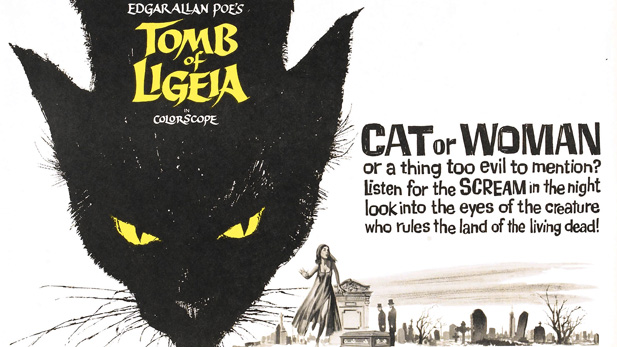
Under the heading of "Reincarnation" we find Tale of Ligeia - a Roger Corman directed film of an Edgar Allan Poe short story, starring Vincent Price.  In this film a cat is possessed by a dead woman's vengeful spirit.

tomb of ligeia black cat poster spotlight
image source: Arizona Public Media website

In the category of "Tramps" we find the movie Down and Out In Beverly Hills where Nick Nolte's character befriends a dog.

DOWN AND OUT IN BEVERLY HILLS, Nick Nolte, Mike the dog, 1986, on all fours
image source: Cineplex.com

Animals and Screen and Radio promotes a broad understanding of the depiction of animals in films from the early silent days up through the 1980s.  This book is useful both for the film buff and for the animal lover, introducing them to new themes and situations highlighting our animal companions and the natural world.  Nowadays through recordings, television, and the internet, a vast range of film is available to us all.  A serendipitous browse through the index and listings of this work could introduce the reader to entertaining and maybe previously unknown or forgotten films.

Animals on Screen and Radio: An Annotated Sourcebook by Ann C. Paietta and Jean L. Kauppila (Scarecrow Press, 1994).

Thursday, October 3, 2013

Weiferd Watts: a Dancer’s Form. Tribute to a beloved photographer

 
Weiferd Watts in his studio.  photo credit: Marvin Collins

Weiferd Watts passed away in 2010. Since then the library has been collaborating with the local dance community to exhibit a small collection of the photographs that tied Weiferd and the dancers together.

Three years ago I picked up In Dance magazine and read an obituary for Weiferd Watts written by a local dancer, Greta Schoenberg.  I got in touch with Greta hoping to curate an exhibit of Weiferd Watts’ work at the library.  This was easier said than done as Weiferd’s largest body of work was not readily available.  A group of dancer’s, including Greta, Selena Chau and Laura Serghiou put out a call to the local dance community for photographs that Weiferd had given to the dancers over the years. These photographs were gathered together and the Art, Music and Recreation Center, with invaluable assistance from the Exhibitions Department, curated the exhibit that is now on view on the 4th floor of the main library in the Music Center.


For over twenty-five years photographer Weiferd Watts captured an incredible array of dancers and athletes from around the US and abroad. He became a well-known fixture in the Bay Area dance community and counted among his subjects dancers from America’s top companies. Removed from the traditional setting of the stage, the intimate portraits he created required the eye of a choreographer. Without any dance training, he would contort his body in an attempt to demonstrate his visions for movement, which were then interpreted by his subjects, yielding extraordinary results. His vast body of work represents several generations of artists captured in magical, elusive moments created through collaborative experiments and pure serendipity.
 
Weiferd’s work captured the fleeting presence of a generation of dancers from our community and documented a unique collaborative process between two disciplines. Dance and photography were his passions and both fields will mourn his early loss for years to come. Let us enjoy what he left behind.
 
The exhibit will run from September 21st, 2013 through January 2nd, 2014


Thursday, September 19, 2013

Richard Diebenkorn and Ingleside

Source: 1938 Aerial view of San Francisco, from the David Rumsey Map Collection

An earlier blog entry, "Richard Diebenkorn's San Francisco Childhood," noted that Richard Diebenkorn lived at two addresses in the Ingleside Terraces neighborhood of San Francisco.  First from around the ages of 9 to 11 he and his family lived on Cedro Way (the red X) and later from around the ages of 12 to 15 they lived on Moncada Way (the green X).

By the time that Diebenkorn embarked on a career as an artist in his twenties, he and his family had moved out of San Francisco.  During the late 1940s he continued living in Northern California in Sausalito and Oakland.  He returned to the Bay Area during the years 1953-1966 -- the time period of the current exhibit at the DeYoung Museum documenting Diebenkorn's Berkeley Years.

While he painted many California landscapes and many of his abstract works evoke the California landscape, he did very little San Francisco-themed work.  Hilton Kramer writes of Diebenkorn's style, calling it a "style that evoked, without explicitly depicting, an imagery drawn from the broad, sunny, open, uncluttered landscape of Northern California as it was ... in the late forties and early fifties."  Much of the San Francisco landscape might have been too crowded and cluttered for that aesthetic, with one exception it turns out, Diebenkorn's Ingleside (properly speaking Ingleside Terraces).

http://uploads8.wikipaintings.org/images/richard-diebenkorn/ingleside.jpg!Large.jpg
Richard Diebenkorn, Ingleside (source: Wikipaintings)

Diebenkorn painted Ingleside in 1963 while living in Berkeley.  In choosing a location to paint, Diebenkorn once said that "clarity of light, space, spareness, expansiveness, contrast" mattered to him the most.  And he certainly found those qualities in his Ingleside landscape. 

Gerald Nordland writes that this painting is:
... a skillful projection of that residential subdivision in deep space, following a suburban street across three intersections and up a hill, with rows of houses on either side, reflecting strong mid-day light.  There are surprising incidents of color and telling touches of impasto white in the buildings which are set off by acres of steel-gray macadam.
Roads and sidewalks meander in unexpected ways forming both curves and straight lines.  Sidewalks frame blacktop, hills in the background contrast the flat land of the foreground.  Grass and trees trim the edges.  There are individual homes in toward the front and rows of less distinct houses on the distant hillside.
Image Number: SFP22-0110
The 200 block of Moncada Way ca. 1920, from the Willard E. Worden Glass Plate Negative Collection, in the San Francisco Historical Photograph Collection

This historic photograph shows Moncada Way about 15 years before the Diebenkorns moved there (their house was later built in the open space at the lower-middle left side of the image).  This photo shows the potential space, spareness and contrast of an earlier time.

The sfog.us website speculates that the scene shown in the Ingleside painting above would be from "Mercedes Way looking south from Paloma Avenue, with Merced Heights in the background."

It's not really possible to pinpoint a location that Diebenkorn was trying to depict, and in actuality it may have not been a distinct location at all.  In the book A Sense of Place: The Artist and The American Land Diebenkorn told about revisiting his old neighborhood to work on this artwork:
Visiting there thirty years later provided me with a peculiarly concentrated subject matter, one which represented much that I had rejected in intervening years but which at the same time referred largely to what I am. A sense of place was built into my use of this material. I made on-the-spot sketches that were very brief, finding that when I painted from them in my Berkeley studio the relevant detail filled in easily. The pictures that came out of this don't refer to specific streets and houses but I believe are very much about the place, Ingleside. 
Diebenkorn sought an ideal landscape from a setting familiar to him from his youth.  It is also worth noting what he chose to take from that landscape.  As the 1920s photograph shows, most of the houses in the neighborhood, particular in the vicinity of the Diebenkorn residences were in an ornate, wooden, craftsman style.  The foregrounded house in his painting are much sparer, white with orange-red adobe roofs.

The view of the neighborhood below from the corner of Corona Street and Urbano Drive includes some houses that are a little closer in style to those of the painting.  (Specifically, look at the houses on the left side of Corona Street - the street heading into the distance from left to right). 

Corner of Corona Street and Urbano Drive from Google Streetview

The view of Merced Heights in the distance is also clear here.  This ridge features a small dip similar to that of the painting between the Lakeview and Ashton Mini-Park at the left and Brooks Park at the right (behind the pole).  The houses in the background, lined up in a row going up the hillside only began to be constructed in the mid-1940s.  There could still have been bare, grassy spots into the 1960s.

Diebenkorn painted a second landscape in the neighborhood entitled Ingleside II.

Ingleside II (source: Christie's - the painting sold at auction on May 15, 2013)

Hilton Kramer has described this work as one of Diebenkorn's "most successful attempts at designing in deep, illusionistic space.  The pictorial reconstitution of the scene on the flat surface of the canvas is given priority over the painterly inflection of the surface itself."  This painting, like Ingleside, also features streets, sidewalks, lawns and a relative sparsity of dwellings.  The scene itself is reminiscent of the portion of the Ingleside Terraces neighborhood near Holloway Avenue shown below.

 Corner of Monticello Street and Holloway Avenue from Google Streetview

Diebenkorn discussed how the environment he worked from affected him approach to art:
My sense of place is involved with particular pictures and subjects whereas my present environment has to do in a more general way with light, coloring, and configuration.  I painted the Ingleside series in a very different environment (although it was at most fifteen miles distant) from Berkeley's.  Could I have painted Ingleside while working in Albuquerque or Los Angeles?  We can probably agree that the sources for painting are incredibly tangled and we had better hope they stay that way.
The Ingleside paintings reflect this "tangled" perspective on a place that would have been familiar and likely endowed with unique meaning to Diebenkorn.  The streets, houses and terrain of Ingleside Terraces under his brush retain recognizable features of the neighborhood, however he presents a sparer, purer vision than a fully developed and populated space would allow.  The Ingleside of his eye and his mind's eye provides a rich painterly space, and for those of us who know the neighborhood and gain a new outlook on this place.


Bibliography:

Alan Gusow, A Sense of Place: The Artist and The American Land (Friends of the Earth, 1972).

Hilton Kramer, "Pure and Impure Diebenkorn," Arts Magazine (December 1963), 46-53.
RichardDiebenkorn: Paintings and Drawings, 1943-1976, with essays by Robert T. Buck, Jr., Gerald Nordland ... (Albright-Knox Art Gallery, 1976).

Friday, September 13, 2013

Merola Goes to the Movies: La Traviata (1982)

Please join us this Sunday in the Koret Auditorium for the 1 p.m. screening of Franco Zeffirelli’s La Traviata (1982).  Hosted by the Merola Opera Program and the Art, Music and Recreation Department, this film is the first of a five-part series, Merola Goes to the Movies, which aims to bring opera's finest adaptations to celluloid into our library screening room.  Each film will be introduced by a knowledgeable Merola representative.

For those unfamiliar with the Merola Opera Program, for 56 years it has been regarded as the world's foremost opera training program for aspiring singers, coaches and stage directors. As the cornerstone of San Francisco Opera's training and performance programs for promising young artists, Merola has served as a proving ground for hundreds of artists, including Ruth Ann Swenson , Deborah Voigt , Anna Netrebko, Patricia Racette, Sylvia McNair, Thomas Hampson, Carol Vaness, Joyce DiDonato, Susan Graham, and Dolora Zajick among many others.

Our Merola Goes to the Movies series begins with Zeffirelli’s La Traviata (1982) a film many critics deem the height of opera’s cinematic expression.  Before skyrocketing to directorial fame for Taming of the Shrew (1967) starring Richard Burton and Elizabeth Taylor and Romeo and Juliet (1968) starring Leonard Whiting and Olivia Hussey, Zeffirelli began his career in the 1950s as a designer and director for opera working, most notably, for Luchino Visonti.  According to Richard Fawkes in Opera on Film, Zeffirelli “was longing to combine his love of opera with his love of film, but it took him more than twenty years to achieve his ambition.”
 
Before aiming his intentions on Canadian-born soprano Teresa Stratas who stars as La Traviata’s mesmerizing Violetta, Zeffirelli devoted at least a decade and a half to conceiving, pursuing and negotiating for cinematic adaptations for Maria Callas.  Beginning in 1958, well before he had any film directorial experience, he had proposed to Callas that she star in a filmed La Traviata.  Nervous of film and Zeffirelli’s lack of experience with the medium, she declined.  He later proposed a filmed Tosca, which he had directed her in for stage, but due to the inability to secure the film rights and Callas’ (or possibly Aristotle Onassis’) continued reticence, the closest remnants of her legendary 1964 Tosca performance survive in a 1964 TV special, Maria Callas at Covent Garden.  Despite her increasing retreat from public view and her rebuff of his plans, Zeffirelli had also envisioned Callas for an Aida to be filmed on location in Egypt, but the Six Day War of 1967 brought his planning to a halt.

Over the years Zeffirelli continued to envision filmed operas, even holding a 1979 location scout in Egypt for Aida and storyboarding exercises with Leonard Bernstein (whom he had invited to conduct), but it was not until 1981 that he would achieve his dream of directing an operatic film. That year the Italian state television service, RAI, invited Zeffirelli to film the opening night broadcast of Cavalleria Rusticana and Pagliacci at La Scala.  Zeffirelli agreed, on the condition that he could make a film--using a closed house, the La Scala sets, orchestra and performers--not just shoot the live operatic performance.  RAI agreed and the director proceeded to film both operas in two days, managing to finish in time for the normal live evening performance to take place as scheduled.  Both were well-received but Pagliacci, starring Placido Domingo and Teresa Stratas, also later won an Emmy.  Their success created the opportunity for Zeffirelli to bring his stars to Rome for filming on sets of his own design to create an award-winning La Traviata, the operatic film he had first imagined over twenty years prior.

Sources consulted:
Opera on Film by Richard Fawkes.
London : Duckworth, 2000.
782 ZF2872o 

Encyclopedia of Opera on Screen : a Guide to More Than 100 Years of Opera Films, Videos, and DVDs by Ken Wlaschin.
New Haven : Yale University Press, c2004.
Ref 782 ZW796o 2004