Showing posts sorted by relevance for query columbus. Sort by date Show all posts

Monday, July 20, 2020

Christopher Columbus at Coit Tower

Christopher Columbus statue on August 6, 1957 before it was shipped to San Francisco (source: San Francisco Historical Photograph Collection)

On November 19, 1964, Herb Caen reported in his column:

SENTIMENTAL JOURNEY: A lonely traveler named Vittorio di Colbertaldo arrived here via Pan Am from Indonesia yesterday at 6 a.m. Since his plane to N.Y. (and on to Rome, where he lives) didn't leave till 10 a.m., he had time to kill. So he took a cab to Telegraph Hill, where he stayed for an hour or so gazing at the statue of Christopher Columbus on the plaza below Coit Tower. In 1957, he had sculpted that $50,000 statue in Rome, hadn't seen it since, was pleased to find that "it seems to be happy here."

Recent years have not been happy for Colbertaldo's creation.  In 1991 the statue's hands were spattered with red paint by protesters pointing out the decimation of indigenous peoples carried out by him and later explorers.  Since then statues of Columbus have prompted protests and vandalism all across America. A month ago (June 18, 2020) the mayor and the Art Commission ordered that San Francisco's Columbus statue be removed from Pioneer Park.

Christoforo Columbo was a native of the Republic of Genoa and a representative of the Crown of Castile when he traversed the Atlantic Ocean.  He never set foot upon American soil and could not properly be called an Italian citizen because there was no Italy in his day.  Yet he was venerated by American settlers since the 18th century and became an emblematic figure for the Italian-American community.

Columbus was a unifying figure for Italian immigrants trying to highlight their identity within the wider American culture.  San Francisco's Italian Heritage Parade traces itself back to "grand processions and festivities" held by the Italian community in 1869 to "celebrate the anniversary of the discovery of America by their fellow countryman."

For many years it was called the Columbus Day Parade.  Charles Speroni's photograph of the 1947 celebration shows a spectacle that is very jarring to contemporary sensibilities.  We see Italian-Americans variously dressed up as Columbus, missionaries, conquistadors, and as native peoples depicted as Plain Indians in feathered headdresses.  Columbus's voyage was conflated with the conquest, civilization and christianization of America.

source: Marysville Appeal Democrat September 23, 1964 [from Newspaper Archive]

A reporter visiting San Francisco's 1964 Columbus Celebration pointed out that his 1492 expedition discovered the Bahamas not America and detected imperialist overtones in the statue: "Many newcomers are startled to find Columbus standing gazing proprietarily toward the Golden Gate." In the 1950s and 1960s Columbus was still a source of national pride for Italians and Americans alike.  Scholarship and advocacy during the 1960s also began to paint a very different picture of Christopher Columbus and the European conquest and settlement of the Americas.

The statue of Christopher Columbus was proposed in a presentation to the San Francisco Art Commission on November 5, 1956 by the Consul General of Italy, Pierluigi Alvera. His letter to the Commission referenced support from Mayor George Christopher and "local civic leaders of Italian ancestry." He had Colbertado's design in hand and the backing of the City's Italian-American community who would raise the funds to pay for the statue.  The Italian government and the city of Genoa would also contribute to pay the expenses. Alvera claimed that:
Among the people who are interested in this project there is the feeling that an ideal location for the statue would be the panoramic circle at Telegraph Hill, replacing the scattered vegetation that is now at the center of the parking place.
The Dedication of the Christopher Columbus Statue (source: San Francisco Historical Photograph Collection)

At the statue's dedication on October 12, 1957 the Consul General emphasized to his California audience that "Columbus was the first European pioneer."  Entertainment for the festivities was provided by the City's Municipal Band and the University of California Glee Club. The Knights of Columbus and the Color Guard of the Italian Navy added to the pageantry.  Dignitaries in attendance included the head of the Italian delegation to the United Nations, a U.S. State Department representative, and Senator Thomas H. Kuchel.

The dedication also included a communique from the Vatican City.  For the occasion, Pope Pius XII declared:

Because of the many benefits which have derived from the discovery of the new continent, Christopher Columbus can justly be considered a benefactor of mankind. His heroic exploits opened up besides a wide field of expansion for the church. The preachers of the Gospel who accompanied the people that followed him, sent there by the Pontiff, brought to these land the Christian faith…

That is not a widely defended view today. The selection of this statue did generate controversy at the time, but it was not connected to Christopher Columbus's legacy or connections of sculptor Vittori de Colbertaldo to Italian fascisim.

That's the subject of the next blog entry.


The JStor, Newspaper Archive, San Francisco Chronicle Historical, San Francisco Examiner Historical and San Historical Photograph Collection databases were all used in this research.


Bibliography:

"'Blood' On Columbus's Hands," San Francisco Examiner October 13, 1991.

Caen, Herb, "Big Wide Wonderful Whirl," San Francisco Chronicle November 19, 1964.

"The Columbus Celebration -- Grand Procession and Festivities at the City Garden," San Francisco Chronicle October 19, 1869.

"History," Italian Heritage Parade San Francisco [webpage].

"K. of C. Raps Aid To Tito," San Francisco Examiner May 19, 1957.

Keeling, Brock, "S.F. Quietly Puts Statue of Genocidal Explorer Into Hiding," Curbed San Francisco June 20, 2020.

McQuigg, Clancy, "Bronze Image of Columbus," San Francisco Examiner October 13, 1957.


Pius XII, "Pope Writes of Columbus," San Francisco Examiner October 13, 1957.

"S.F.'s 'Festa Italiana" To Honor Columbus," Marysville Appeal Democrat September 23, 1964.

Speroni, Charles. “The Development of the Columbus Day Pageant of San Francisco.” Western Folklore, vol. 7, no. 4, 1948. [available in JStor]

Tuesday, June 7, 2022

Smashing Statues: The Rise and Fall of America's Public Monuments

The edifice for the toppled statue of U.S. Grant in Golden Gate Park

The early summer of 2020 brought a wave of iconoclasm to America and San Francisco. Locally, the statue of Christopher Columbus on San Francisco's Telegraph Hill was vandalized and preemptively removed. Statues of Francis Scott Key, Junipero Serra and Ulysses S. Grant were toppled. A statue of Manuel Cervantes was also vandalized.

Erin L. Thompson's Smashing Statues examines both the reasons for erecting and toppling public monuments. For Thompson "monuments aren't history lessons"; they come into existence to serve the interests of the powerful in society. She also opines that the vandalism and destruction of these monuments "happens when people who lack the power to change a political regime attack its symbols."

She devotes a good deal of space to the post-reconstruction proliferation of Confederate monuments in America's South. These were transparently commissioned and created as weapons to enforce the violence of segregation and inequality. Thompson describes them as "hatred hardened into marble and bronze." She advocates for their removal noting that it is not enough to add contextualizing language or supplement them with additional artworks as a counter-balance.

But she does present a different perspective on these monuments from John Guess Jr., the CEO of the Houston Museum of African American Culture. He reminds us that they are evidence of past wrongs telling Thompson that "I like to keep the evidence," because "down the road, people might suggest there was never a crime."

It's also an oversimplification to view monuments as only statements made by the powerful. Many San Francisco monuments were actually the result of nationalistic sentiments of immigrant communities who were unsure about their position in society. We have written elsewhere about the statues in Golden Gate Park of Ludwig van Beethoven and Giuseppe Verdi that were the efforts of the City's German-American and Italian-American communities, respectively. The vandalized Manuel Cervantes statue there was likewise commissioned and dedicated by the City's Spanish-American community.

That brings us back around to Christopher Columbus to whom Thompson devotes a chapter. She traces the origins of the myth-making around Columbus (who never set foot in the United States) to the desire of a young nation to sweep away its own problematic colonial origins and search for an alternative hero. America today has a difficult time ascribing heroism to Columbus's actions in the "new world" and places him at the head of a different origin story that resulted in genocide and the destruction of indigenous cultures.

The proliferation of Christopher Columbus statues in the United States resulted from benign intentions. Italian immigrants to the United States found themselves stuck in the margins of acceptable society and were themselves subjected to discrimination. They saw in their countryman Columbus the opportunity to align themselves with mainstream America and began agitating for Columbus Day as a holiday and organizing Columbus Day parades.

The empty edifice of the Christopher Columbus statue on Telegraph Hill.
This was a new edifice dedicated during Willie Brown's term as Mayor (1996-2004) with the participation of representatives from Genoa and Liguria, Italy) 

The statues of Columbus were a natural outcome of these efforts even though the depiction of Columbus was problematic. Thompson notes that there are no authentic portraits made of the explorer. Any representation of his features is guesswork.  

Over time Mr. Columbus became the fulcrum of two equal and opposite impulses. He embodied the desire of Italian immigrants to represent themselves as assimilated, ennobled and fully American. At the same time, indigenous Americans see Columbus as a tormentor who stole their land. The Italians sought the assimilation that indigenous Americans explicitly reject and fight against.

Thompson met with Mike Forcia, a native American activist who struggled for years to have a statue of Columbus removed in St. Paul, Minnesota. The protests following the murder of George Floyd in June 2020 provided him the opportunity to organize a crowd to pull the statue down. This was a criminal act and he was charged with a felony. The prosecutors decided not to press on with the charges if Forcia agreed to perform 100 hours of community service in the interest of repairing the harm and trauma that the statue represented. As he put it: "once it [the Columbus statue] hit the ground, those conversations started happening."

That act of iconoclasm opened up the public sphere to education and dialogue. But this was not due solely to the act of forcibly removing the statue but also due to past presence of the statue. Once the 100 hours were completed and the injurious symbol was removed, the space for continued conversation was diminished.

Thompson brings up the very excellent point that for concerned citizens like Forcia there are not yet established orderly, democratic ways of removing public monuments. But given all of the contention and competing interests in American society it could be difficult to reach a consensus about the fate of our public art and monuments. Smashing Statues is an excellent introduction to issues that underlie this dilemma.

Smashing Statues: The Rise and Fall of America's Public Monuments by Erin L. Thompson (W. W. Norton & Company, 2022).

Friday, July 24, 2020

Christopher Columbus at Coit Tower - The Graziotti Design


Christopher Columbus at Coit Tower [first part]

Heresy Labs, which describes itself as an "autonomous media project exploring anti-authoritarian politics and monitoring fascist presence within cultural space" tweeted the following on June 18, 2020:
The Christopher Columbus statue at Coit Tower in San Francisco has been removed. It was sculpted by fascist Vittorio di Colbertaldo who was Mussolini's handpicked bodyguard.  
The Christopher Columbus statue was controversial when it was erected in 1957, however, this controversy had nothing to with the sculptor's affiliation with the Italian Fascist Party.

Vittorio di Colbertaldo was undoubtedly an active participant in Italy's fascist movement in the 1930s and 1940s.  But during the Cold War that followed former fascists probably came to be seen as strong anti-communist allies.  In any case, Colbertaldo's past political affiliation was no impediment to his post-war art career.

The Italian consul general Pierluigi Alvera had recommended Vittorio di Colbertaldo to the Art Commission for the project as "one of the world authorities on Columbus."  But in their final decision the art commissioners also considered a proposal from a San Francisco artist Ugo A. Graziotti.

The controversy about the Christopher Columbus statue played out in the Letters to the Editor pages of San Francisco's daily papers.  According to a January 29, 1957 letter to the Chronicle, Graziotti claimed that he had suggested the idea of commissioning a Columbus statue for San Francisco to Alvera in January of 1956.  According to him, Alvara followed up this idea by contacting and commissioning Colbertado. In October 1956 he presented a sketch of this artist's sculpture design to the Art Commission.

Graziotti said that Alvara told him:
"If I wanted to, I could submit a design." And may I say that I was told this in a very unsympathetic way. In other words, Dr. Alvera asked me for a design just to toss me a bone for my idea.
Italian Consul general Pierluigi Alvera with a model of the Columbus statue (source: San Francisco Examiner January 4, 1957)

After the Art Commission vote, a Dick Nolan column in the Chronicle reported that the Art Commission's selection of the Colbertaldo had been generated strong community opposition:
The panel rejected a more daring design by Ugo Graziotti, a local master, for a more conventional piece of sculpture by an Italian who also happens to be a friend of the Italian consul, Pierluigi Alvera. The commission, from all reports, based its decision on financial reasons rather than esthetic ones. Alvera somehow conveyed the impression that his man's work was all bought and paid for and hence no problem to install, subito and toot de sweet.
(A side note: one of the Art Commissioners favoring the Colbertaldo work was one of Graziotti's students.)

source: San Francisco Examiner January 24, 1956

Ugo Graziotti (1912-2000) was a native of Brescia, Italy.  While working at the Accademia di Belle Arti di Roma he was invited in 1949 to teach in the United States in 1949 where he lived until 1970 when returned home to Italy.  He lived in the Bay Area from 1954 to 1967 where he taught at the California College of Arts and Crafts, Art League of San Francisco and the University of San Francisco. He also operated the Graziotti Studio of Fine Arts that was located adjacent to today's Main Library at 1254 Market Street. His art was exhibited at the DeYoung Museum and the California Academy of Sciences.

In the run up to the Art Commission vote in January 1957, Graziotti presented his vision of Columbus to the Examiner.  He told them that he wanted to create a statue:
To harmonize with the distinctive characteristics of San Francisco, and with the time in which we live. It is not intended to be just another neo-classic monument, similar to so many pieces reflecting 19th century taste to be seen here and there about the city. It is designed to provide interest to the spectator from every angle, whether seen from a distance or close at hand.
The mosaic under the statue was meant to depict the known world at the the time of Columbus. The bronze base was intended to represent a ship. The bronze figure showed Columbus gazing forward with his hands clasping the vessel's pilot wheel.

Ugo A. Graziotti's Columbus Statue design (source: San Francisco Examiner December 13, 1956)

Three letters to the editor supporting Graziotti's design were printed in the San Francisco Chronicle of January 24, 1956.  The writers advocated supporting a locally known artist like Graziotti.  They criticized the conservatism of the Colbertaldo design.  One correspondent advocating for Graziotti's design wrote that:
It reaches and exhibits the living spirit of every pioneer, every giant, every man who, with strength and faith, fights for discoveries and for a better world... it is a monument to the Relentless American.
Part of the contemporary opposition to the Colbertaldo statue in Pioneer Park was probably due to the depiction of the explorer like a dauntless conqueror.  The Graziotti work with its symbolism, abstract elements, and even a degree of whimsy might have rankled the today's viewer less than the Colbertaldo statue.

Nevertheless, Graziotti cannot be separated from association with Italian fascism.  He published examples of his work in the magazine Goliardia Fascista, a fascist affiliated student newspaper, between 1936 and 1939.

The next installment of this blog will take a closer look at Vincenzo di Colbertado -- his work and his connection to fascism.


The Newspaper Archive, San Francisco Chronicle Historical, and San Francisco Examiner Historical databases were all used in this research.


Bibliography


Benoit, Monique, "'The City Ignores Its Local Artists'," San Francisco Chronicle January 24, 1956.

Bergman, Harry, "An Artist Leaves The City," San Francisco Chronicle September 3, 1967.

"Columbus Statue Designed for S.F.," San Francisco Examiner December 13, 1956.

Cross, Miriam Duncan, "Gold's But One Treasure In De Young's Current Exhibit," Oakland Tribune June 6, 1954.

"The Editor's Mailbox," San Francisco Examiner January 16, 1957.

"Graziotti Adriano Ugo," Dizionario pittori e scultori Bresciano [online]

Hulburd, David, "Talk Around Town," San Francisco Chronicle January 27, 1957.

"It Was A Tough Break For Columbus Statue," San Francisco Examiner January 4, 1957.

"Letters To The Editor," San Francisco Chronicle January 24, 1957.

"Letters To The Editor," San Francisco Chronicle January 29, 1957.

McQuigg, Clancy, "Bronze Image of Columbus," San Francisco Examiner October 13, 1957.

Nolan, Dick, "Lakeshore Citizens Take G.E.T. Fight To Mayor," San Francisco Chronicle January 13, 1957.

"Polyhedra Forms To Go On Display," Sausalito News April 18, 1962.

"Statue, Landscaping Tentatively Approved," San Francisco Chronicle October 26, 1956.

"Ugo Andriano Graziotti," Wikipedia: L'enciclopedia libera [online].

Watmough, David, "Books, Sunshine, Women and Sculptor Ugo Graziotti," San Francisco Examiner December 27, 1959.

Wednesday, October 21, 2020

Christopher Columbus at Coit Tower - The Fascist Sculptor

This is the third of three entries about Christopher Columbus at Coit Tower. See the two previous installments:

"Christopher Columbus at Coit Tower" (July 20, 2020)

"Christopher Columbus at Coit Tower -- The Graziotti Design" (July 24, 2020)

Vittorio di Colbertaldo, the sculptor of the statue of Christopher Columbus that had been located at Pioneer Park near Coit Tower on Telegraph Hill, was undeniably a fascist. That affiliation was part of rationale for the statue's removal in May 2020. As we have discussed in the previous entry of this blog, Colbertaldo's prior politics and ideology did not prove to be an impediment to the his post-war career.  In this entry we will look at how fascism informed his artwork.

What exactly is fascism?  According to Britannica, it is a kind of "militaristic nationalism" based upon a "belief in natural social hierarchy and the rule of elites."  Colbertaldo was born in 1901 into such an elite having descended from the Bassanese nobility (Bassano del Grappa). He also shared his birthplace in Forli with the Duce of Fascism, Benito Mussolini.

Colbertaldo had a conventional art career. He studied at the Accademia d’arte Cignaroli in Verona. He later taught at Guidizzolo School of Art in the province of Mantua and at the Liceo artistico statale (State Arts Lyceum) in Rome from 1935.  In addition to working in three dimensional media he was also an illustrator for the Milan-based magazine L'Eroica (The Heroic).


Di Colbertaldo's earliest public artwork is memorial to the World War I soldiers who lost their lives from the commune of Arcole in Veneto. This work, created in 1928 during the rule of the National Fascist Party government, projects a muscular nationalism in its depiction of the Italian men who fought the Austro-Hungarian empire between 1915 and 1918.

Imperial ambitions were always part of the Italian Fascist project. Italy had conquered and colonized Libya since 1911 and invaded Ethiopia (which they called Abyssinia) in 1935.  Colbertaldo created works promoting his nation's colonial ambitions that were featured in the Italian Pavilion at the 1939 New York Worlds Fair.

"Abissino" (Abyssinian), source: Icone d'Oltremare nell'Italia fascista

The exhibition featured several works in bas-relief depicting Italy's colonized subjects in Libya and Ethiopia. According to Pretelli one of principal aims of the Italian pavilion at the World's Fair was "to show a brand new Fascist 'spirit' generated by the proclamation of the empire." Italian colonization was portrayed as "pacific and laborious" demonstrating the "supposed civilization of the Ethiopian territories achieved under fascist occupation."

"La fraternità delle armi e del lavoro nella conquista dell'Impero," source: Prima Mostra Triennale delle Terre Italiane d'oltremare

Colbertaldo's enthusiasm for Italy's imperial ambitions are clearly manifested in "The Brotherhood of Arms and Labor In the Empire's Conquest" (La fraternità delle armi e del lavoro nella conquista dell'Impero), a statue displayed at the East African pavilion of the First Triennial Exhibition of Italian Overseas Lands (Prima Mostra Triennale delle Terre Italiane d'oltermare) in Naples in 1940. Linked soldiers and workers march forward for Italy's glory.

"Monumento al Duca d'Aosta," source: Fondazione Cassa di Risparmio di Gorizia

Even after the Fascist government was overthrown and Italy and the Axis nations were defeated in World War II, Colbertaldo returned to military and imperial themes. In 1965 (several years after his Christopher Columbus commission) he created a memorial to Prince Amedeo, Duke of Aosta, the Viceroy of Italian East Africa who commanded Italian forces there during the war and surrendered to the Allies and died in British captivity in 1942.

"Telegraph Hill," July 21, 1960, source: OpenSFHistory / wnp27.5147.jpg

Was the statue of Christopher Columbus atop Telegraph Hill an expression of fascism? It was certainly an expression of both Italian nationalism and conquest.

"Christopher Columbus," image source: Public Art and Architecture From Around The World, May 23, 2012

We can see in di Colbertaldo's Christopher Columbus the many of the same qualities as his other works. The subjects depicted share a sober virility and project a heroic chauvinism. They gaze forward in full control of their emotions. The Public Art and Architecture From Around The World blog features several views of the now-removed Columbus statue. The comments to this blog entry are striking because they describe this now disreputable work as "wonderful" and "commanding" -- both reasonable aesthetic reactions. It is a well-rendered imposing statue. Given that Christopher Columbus is not well-known by his image, the millions of tourists who passed the statue probably gave little thought to the statue's origins or meaning. It was just another heroic statue.

Vittorio di Colbertaldo was an active artist up to his death in 1979.  His post-war output exhibited a surprisingly wide.  He created works for a Via Crucis at Dachau honoring Italians who died at the concentration camp.  He continued specializing in monumental works, sculpting statues of disparate figures such as Jan Palach, a young Czech who self-immolated in opposition to the Soviet occupation of his country, Prince Diponegoro, 19th century Javanese ruler who fought Dutch colonial rule in Indonesia, and Rashid Karami, a Lebanese prime minister.

image source: Rerum Romanun

The memorial to Jan Palach in Rome from 1970 is remarkable presenting the young hero dwarfed by tongues of flame.

Colbertaldo's statue of Christopher Columbus is unlikely to ever return to its pedestal upon Telegraph Hill. The statue has a twin in Miami, Florida that is still standing but has also been vandalized and threatened with removal.  Christopher Columbus statues are in peril all across the United States. Colbertaldo's San Francisco creation is fortunate to have escaped into storage. Some Miamians want to bury the explorer under water, upside down in the sand.

Bibliography


Ceballos, Joshua, "Gramps Owner Offers To Sink Columbus Statue Into The Sea," Miami New Times [online] June 12, 2020.

Comanducci, A. M., Dizionario illustrato dei pittori: disegnatori e incisori italiani moderni e contemporanei (L. Patuzzi, 1970).

"Fascism." Britannica Library, Encyclopædia Britannica, 22 Feb. 2019.


"Monumenti e lapidi," 14-18 Documenti e immagini della grande guerra [website].

"Il monumento ai Caduti di Arcole," Arcole Racconta [blog] October 31, 2013

Merjian, Ara H., "Learning From Fascism," Art In America [online] April 1, 2019.

"Monumento al Duca d'Aosta," Fondazione Cassa di Risparmio di Gorizia [webpage].

Pretelli, Matteo, "Italian Migrants in Italian Exhibitions from Fascism to the Early Republic," in Moving Bodies, Displaying Nations National Cultures, Race and Gender in World Expositions Nineteenth to Twenty-first Century (Edizioni Università di Trieste, 2014).

"Prince Amadeo, Duke of Aosta," Italy On This Day [blog], October 21, 2018.


"Status di Jan Palach," Rerum Romanarum [website] 

"Vittorio de Colbertaldo scultore in quattro continenti," Corriere Romagna (July 2, 2018).


Wednesday, October 16, 2024

Maya Angelou and the Purple Onion

Another pioneer offbeat, avant-garde, and/or existential cellar, with a more or less continuous show featuring folk singers, monologists, and comics of the cerebral variety.
That was the legendary Herb Caen's appraisal of the Purple Onion. An off-shoot of of Enrico Banducci's legendary hungry i, the Purple Onion opened in early 1953.

Weep not for the hungry fellows who run the "hungry i" tavern on Columbus avenue. They'll do their own weeping in a branch they're opening across the street to be called "The Purple Onion"... (San Francisco Chronicle December 18, 1952)

According to Phyllis Diller, Keith Rockwell, a co-owner of the hungry i, left his partnership with Banducci to open the Purple Onion as a vehicle for the "chanteuse" Jorie Remes. Diller wrote that Rockwell, who "absolutely adored her," was also a musician who played string bass.

Jorie Remes (Marjorie Remes who was later was known as Jorie Remus) was a native of New York City. She perfected her craft in the early 1950s at La Boite de Sardines [Sardine Tin] along the Paris Champs Elysees. "Jorie Remus was too hip for the room before being too hip for the room was a thing, and almost even before there was a room worth being to hip in." That is the appraisal of Shawn Levey in his book In on The Joke: The Original Queens of Stand-Up Comedy.

source: San Francisco Chronicle May 9, 1953

She was a singer and monologist who sang and wrote her own material that she called "20th Century Laments." Historian and former Chronicle theater critic Gerald Nachman designated her as one of the "foremothers" of stand-up comedy. Phyllis Diller described her as "a willowy, sexy, French chanteuse-type with a husky voice, a droll sense of humor, and haughty, heaving affected manner." By November 1953, a Chronicle columnist remarked that crowds lined up outside the Purple Onion's door to watch her performance. When Variety magazine reviewed her act they noted that she projected "warm cynicism" and that she "has a knowledge of humor in its less blatant forms."

At the same time that Remes was putting the Purple Onion on the map as a destination for the night hawks of San Francisco, Maya Angelou, then going by Marguerite Angelos, was in the process of divorcing her husband. Her savings were dwindling so she went looking for work in San Francisco's International Settlement. This was the entertainment district that supplanted the former Barbary Coast occupying Pacific Avenue between Montgomery and Kearney Streets.

In her memoir, Singin' And Swingin' and Gettin' Merry Like Christmas, Angelou remembered how the block had four strip joints. She found work as a showgirl at one of them -- the Garden of Allah. (Angelou may have changed the name of this establishment -- it is not listed in the city directories or phonebooks of that time). Once the management discovered her expressive skill as a dance, they had her perform her artistic routines fully clothed and she started bringing in a different clientele. The audience transitioned from lonely old men to "laughing open faced couples" who came to see her.

One night she noticed a party of four - three men and a woman. Angelou described the latter, Jorie Remes, as a "young Marlene Dietrich-looking woman" with a shock of "sunlight-yellow hair." They were all from the Purple Onion, just a few blocks away. Word had spread about this expressive dancer. Angelou wrote:
These beautiful people and their friends began dropping in each evening and I awaited their arrival. I danced indifferently until I caught a glimpse of their party near the back of the room, then I offered them the best steps I had and as soon as the dance was finished I hurried over.

Remes had accepted a gig at a New York nightclub for the new year and the club was looking for a new headliner to replace her. They learned that Angelou was being let go by her club and wondered whether she could sing as well as dance. She volunteered that she could and hey found her a vocal coach and helped her work up a repertoire of songs. She and the rest of them even brainstormed her new stage name. Maya (a truncation of Marguerite) was a nickname her brother familiarly called her and Angelou was adapted from her married surname - Angelos.


With Jorie Remes on her way to New York City, the Purple Onion debuted the name and persona Maya Angelou ("The New Singing Sensation") in their advertisement in the Chronicle of January 2, 1954. The Chronicle's nightlife correspondent, who went by "The Owl," excitedly announced on January 9, 1954 that:
The Purple Onion now has a bigger and better show with that young romantic baritone Patrick McVey and that new sensational find Maya Angelou. The Owl predicted she would make you forget Jorie Remes.
He later noted audiences frequently requested her rendition of the Louis Jordan song "Push ka pee she pie." He continued to gush:
The exotic Maya Angelou, now appearing at the Purple Onion, has more expression in her hands than most singers have in their faces. You really have to see Maya's graceful gestures to appreciate her.

Maya Angelou is the spellbinder at the Purple Onion. One moment the passion flower sings quietly and demurely and suddenly, she erupts in strictly spontaneous combustion. An artist with both delicacy and fire, Miss Angelou is certainly the most expressive singer in these parts.
After this auspicious start, her show business career took off. She continued her run at the Purple Onion through the end of August 1954. She then joined a European tour of Porgy and Bess as a dancer. While in Paris she headlined at a nightclub.

Mars-Club presents Maya Angelou (source: New York Herald Tribune October 2, 1954)

She returned to San Francisco in September 1955 where she headlined at a new nightclub called the Hollow Egg. We haven't found any photographs of Maya Angelou performing in San Francisco. Fortunately, the 1957 feature film, Calypso Heat Wave documented her act.

Maya Angelou, still shot from Calypso Heat Wave (1957)

Maya Angelou's show business career continued for several more years. She appeared in clubs in Los Angeles and New York. She also recorded a calypso album for Liberty Records in 1957. But her name and her fame started with the Purple Onion on Columbus Avenue.

The Purple Onion in 1964 (source: San Francisco Historical Photograph Collection)

Bibliography

"Americans Make Good as Paris Nitery Ops," The Billboard February 3, 1951.

Angelou, Maya, The Collected Autobiographies of Maya Angelou (Modern Library, 2004).

"The Bachelor," San Francisco Chronicle November 23, 1953.

Caen, Herb, Herb Caen's Guide to San Francisco (Doubleday, 1957).

De Beix, Maxime, "Paris," Variety October 25, 1950

Diller, Phyllis, Like A Lampshade in A Whorehouse: My Life in Comedy (J.P. Tarcher/Penguin, 2005).

Jennings, Dean, "It's News to Me," San Francisco Chronicle December 18, 1952.


The Owl, "After Night Falls," San Francisco Chronicle January 9, 1954

The Owl, "After Night Falls," San Francisco Chronicle February 27, 1954.

The Owl, "After Night Falls," San Francisco Chronicle April 10, 1954.

"Purple Onion, S.F.," Variety August 12, 1953

Steif, Bill, "San Francisco," Variety July 6, 1955


Databases used:

Entertainment Industry Magazine Archive
Gallica
San Francisco Chronicle Historical

Sunday, August 2, 2015

Melvin Earl Cummings - Monumental Sculptor of the City

Only one San Francisco resident was represented in the catalogue for the 1929 exhibition Contemporary American Sculpture presented at The California Palace of the Legion of Honor in conjunction with the National Sculpture Society.  Earl Cummings (Melvin Earl Cummings) also had the distinction of being San Francisco's representative on the Jury of Selection for the exhibition as well as being a member of the Board of Trustees of The California Palace of the Legion of Honor.  (The only other Northern Californian represented in the show was Joseph J. Mora, the sculptor of the Cervantes monument in Golden Gate Park.  Leo Lentelli, who moved to New York and is the subject of an earlier blog, is also included).

Cummings was born August 13, 1876 in Salt Lake City, Utah.  His father Melvin Elisha Cummings worked as a cashier at the Utah Commercial and Savings Bank.  Upon moving to San Francisco he was employed as a clerk for the Board of Public Works.  His grandfather James W. Cummings was a Mormon elder who arrived in the Utah Territory in 1851.  A man of local prominence, he was a Utah State Legislator and a Salt Lake City Councilman.

As a boy Melvin Cummings showed talent for wood carving.  He apprenticed himself to a carver and received training as he worked on the decoration of the Mormon Temple.

He won a San Francisco Art Association scholarship to attend the School of Design of the Mark Hopkins Institute of Art.  Under the tutelage of Douglas Tilden he had completed at least two works "Love and Death" and "Bohemia's Toast to the Owl" (then exhibited at the Bohemian Club).

At age 20 his family moved to San Francisco studied at the Mark Hopkins Art Institute under Douglas Tilden  The 1900 Crocker Langley San Francisco Directory lists Cummings as a student of Douglas Tilden living at 1121 Leavenworth.  He had exhibited a few works when Phoebe Hearst (widow of a U.S. Senator and mother of William Randolph Hearst) noted his talent and sent him to study at the École des Beaux Arts in Paris where he studied with Mercié and Louis Noël.  Below are a few of his Paris works.

Cummings in Paris with "A Portrait Bust" his first work accepted at the Paris Salon (1901)

 Design for A Mausoleum, ca. 1900-1
Les deux puissances, le bien et la mal (The Two Forces: Good and Evil) Paris Salon 1902

He presented one of his Paris salon works, "La Soif" (Thirst - also known as "Man Drinking Water"), as a gift to the City.   This sculpture portrays an elderly man on a rock. Cummings stated that he "donated the little figure to the city because it seemed so appropriate for the neighborhood of Washington Square."  He also noted that the model for this work was the same one who posed for Rodin's work "John the Baptist."

 La Soif in Marini Plaza
La Soif viewed in the context of Columbus Avenue / Washington Square

This 800 pound statue made the news in 1923 when it was feared to have been stolen by "narcotic addicts."  The truth turned out to be far less interesting. The Board of Public Works had considered removing it because they wished to turn the triangular space into a safety zone. Without notifying anyone, the Park Commission transferred the work into storage while they considered an alternate location for it.  In the end the statue was return to its rightful spot and in the process acquired a fountain that accounts for the visible trickle of water on the statue.

The 1905 Catalogue of the San Francisco Art Association noted that Cummings was "employed in a responsible position" for San Francisco's Department of Public Works. At the same time he worked as a professor at the Mark Hopkins Institute of Art where he taught the modeling classes.  He exhibited two works that year, both in plaster - a bust of his teacher Douglas Tilden and the earlier mention "Love and Death" which was owned by Mrs. Hearst herself.

On June 7, 1905 he married Guadalupe Rivas, the daughter of Isaac Rivas, a physician and surgeon who came to San Francisco in 1869 as the Mexican Consul.  Rivas was a prominent member of the community and was an early member of the Bohemian Club.

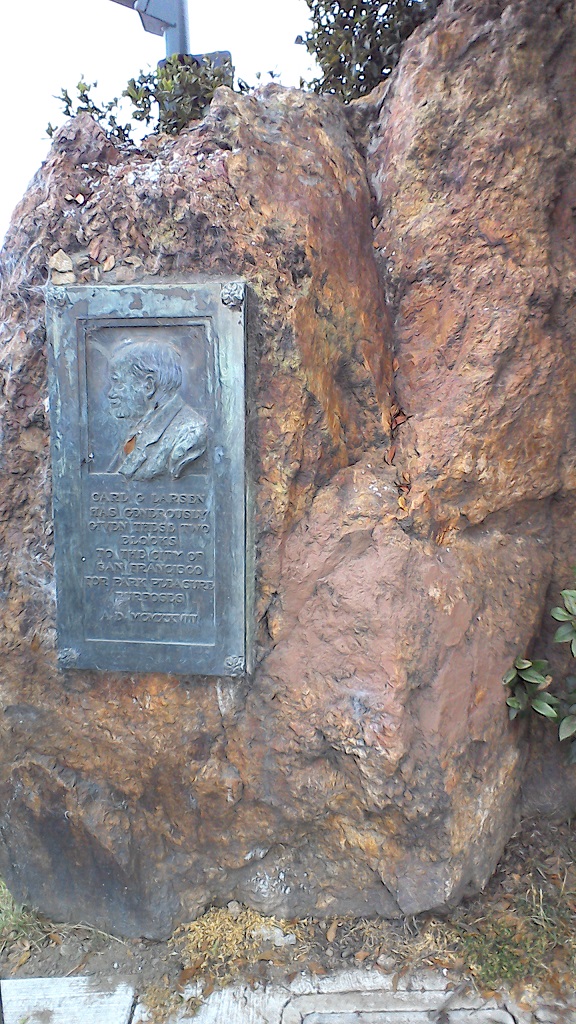
One of Cumming's most easily overlooked works is located in one of the most heavily traveled places in the City.  His commemorative plaque of Carl G. Larsen is visible, though probably unnoticed, to all pedestrians and vehicles on the west side of Route 1 / 19th Avenue at Ulloa Street.


The inscription reads: "Carl G. Larsen has generously given these two blocks to the City of San Francisco for park pleasure purposes A.D. MCMXXVIII."

http://webbie1.sfpl.org/multimedia/sfphotos/AAA-6966.jpg
M.E. Cummings and Carl G. Larsen stand before land Larsen gave city for park (source: San Francisco Historical Photograph Collection).

Cumming's plaque was placed upon a 40 ton piece of stone that was extracted from Golden Gate Heights and moved to Larsen Park.

Cummings created an earlier bronze commemorative tablet in 1921 for the San Francisco Fire Chief's Residence at 870 Post Street memorializing Dennis T. Sullivan.  Sullivan had been the Chief Engineer of the Fire Department during the Great Earthquake and Fire of 1906 who died from wounds sustained during that cataclysm.  The work was commissioned and paid for by the City's firefighters and was placed on the residence when it opened in 1922.

In addition to these public sculptural works Cummings also created a number of works for the Bohemian Club.  He taught modelling in the architecture department at UC Berkeley from 1906 until his death in 1936.
Another one of Cummings' less-noticed sculptures is the pair of mountain lions that border the clock inside the lobby of the former Bank of California.  This work is similar to the bronzes sculptures he created for the 8th Avenue entrance to Golden Gate Park.  Some of his other works include some of the figural work on the Sather Gate on the University of California at Berkeley campus (which caused some controversy at the time) and a statue of Commodore Sloat in Monterey.  He also exhibited works at the Panama Pacific International Exposition in 1915.

Cummings was a person who held great prestige, power and authority in the San Francisco art community. He was a member of the board of trustees of both the California Palace of the Legion of Honor and the M. H. de Young Memorial Museum.  In this capacity he a great influence on the works selected or rejected for the museums.  In 1930 he was even an interim director of the Legion of Honor.

He was also a San Francisco Parks Commissioner from 1904 where he was the mandated artist-member and chaired the advisory committee of artists and architects.  Very much a man of the establishment, he was a member of the National Sculpture Society, the Society of Colonial Wars, the Army and Navy Club, the Society of the Sons of the American Revolution and a member of the Order of Founders and Patriots of America.

He and his wife lived in Pacific Heights at 3966 Clay Street.  Their names appear in the high society San Francisco Blue Book from 1907.  They appear in San Francisco's Social Register from 1914.  Cummings was listed in Who's Who In America from 1906 to 1932.  He is also listed in Who's Who In California in 1929.  He was listed in the American Art Annual in 1910 and 1915.  In 1913 he was also included in the Allgemeines Lexikon der bildenden Künstler von der Antike bis zur Gegenwart.  He receives less mention in more recent reference books.  Nevertheless, the  Allgemeines Künstlerlexikon of 1999 and, of course, Edan Hughes' Artists in California give him substantial mention.

a portrait of Melvin Earl Cummings from the San Francisco Historical Photograph Collection

In his final days he experienced liver and kidney failure and went into a coma.  He died on July 21, 1936 at the age of 59. An obituary of Cummings from UC Berkeley described his as "a naturally quiet and unobtrusive man, though one of intensely social instincts."

He did a substantial amount of work in Golden Gate Park that will be discussed in a later entry.


"Ah-h-a-a! 'Le Soif' is Found," San Francisco Chronicle November 30, 1923

 Allgemeines Künstlerlexikon: Die bildenden Künstler aller Zeiten und Völker, Band 23 (K. G. Saur, 1999).

Allgemeines Lexikon der bildenden Künstler von der Antike bis zur Gegenwart, achter Band, hrsg. von Dr. Ulrich Thieme und Dr. Felix Becker (W. Engelmann, 1913).

American Art Annual (MacMillan Co., 1898-).

American Sculpture: The Collection of the Fine Arts Museums of San Francisco by Donald L. Stover (Fine Arts Museums of San Francisco, [1982?]).

Artists in California, 1786-1940 by Edan Milton Hughes (Crocker Art Museum, 2002).

Biographical Encyclopedia of American Painters, Sculptors & Engravers of the U.S.: Colonial to 2002, compiled by Bob Creps (Dealer's Choice Books, 2002).

California Art Research, volume 6

Catalogue of the San Francisco Art Association, Mark Hopkins Institute of Art (San Francisco Art Association, 1905).

Contemporary American sculpture / The California palace of the Legion of Honor, Lincoln Park, San Francisco, April to October, MCMXXIX ([National Sculpture Society], 1929).

"Cummings, S.F. Sculptor, Dies," San Francisco Chronicle July 22, 1936.

"Death Claims M.E. Cummings, S.F. Sculptor," San Francisco Examiner July 22, 1936

Dictionary of American Sculptors: "18th Century to the Present," edited by Glenn B. Opitz (Apollo, 1984).

"Earl Cummings," San Francisco Call May 6, 1901, 9. [source: California Digital Newspaper Collection]

"Earl Cummings Here: Talented Salt Lake City Artist En Route to Paris," Deseret News September 24, 1900, 2. [source: Google Books]

"40-ton Stone Will Mark Larsen Park" San Francisco Chronicle August 13, 1928, 11

Medders, Stan, "From the Golden Age of City Sculptors," California Living Magazine / San Francisco Sunday Examiner & Chronicle, May 3, 1981. [source: Artists File]

"Melvin Earl Cummings, Architecture: Berkeley," from 1935-36, University of California: In Memoriam (1937), digitized in Calisphere.

"Quintons Quit Legion Palace," San Francisco Chronicle May 8, 1930, 3

"The Recent Work of M. Earl Cummings," The Mark Hopkins Institute of Art Review vol. 1, no. 9 (Mid-summer 1904). [scanned in Google Books]

San Francisco Blue Book (Charles C. Hoag, 1904-).

"Sculptor Cummings Ill," San Francisco Examiner July 21, 1936.
Social Register, San Francisco (Social Register Association, -1976).

Stein, Ken, "Sather Gate's Checkered Past," San Francisco Chronicle (October 28, 2008)

A Survey of Art Work in the City and County of San Francisco, prepared by Martin Snipper for the Art Commission, City and County of San Francisco (1953).

Who's Who in America (Marquis Who's Who, 1906-1932).

Who's Who in California: A Biographical Directory, 1928-29, edited by Justice B. Detwiler et al. (Who's Who Publishing Co., 1929).

"Work of Art Removed From North Beach," San Francisco Chronicle November 29, 1923, A1

Wednesday, November 13, 2013

Faith Petric (1915-2013)

I was born in a log cabin on the Clearwater River near Orofino, in northern Idaho, September 13, 1915.  My father, an itinerant preacher, school teacher, farmer, carpenter, and inventor was "musical" -- he played piano organ, harmonica, a variety of wind instruments and a bit of fiddle, and sang in a fine tenor.  My first singing was in church, in one-room schools, and with my father.  About 1925 I discovered cowboy and country songs, followed by the great protest songs of the 1930s.  And I'm still addicted to all of them. (source: Art, Music and Recreation Center Musicians and Performing Artists file).
We sadly note the loss of a woman who was a San Francisco institution.  Faith Petric, who lived to be 98, passed away on October 24, 2013.  In his book, Which Side Are You On, Dick Weissman accurately described her as "a sparkplug of traditional music in the Bay Area."

We knew her as someone who used the library for her research -- she was someone who knew what she was looking for and quietly went about her business of search for folk tunes and their origins.  Over the years she also performed at the library.

Flyer for a Faith Petric performance, Thursday, January 26, 1984, Folk Music in the Lurie Room, Main Library

Since her father was a union carpenter, she became interested at a young age in the songs of the labor movement.  She was later inspired by a concert given by Carl Sandburg at Whitman College in the 1930s where she bought his seminal song collection, An American Songbag.

Faith Petric first came to San Francisco in 1938.  She recalled first arriving into the city aboard a freighter from Seattle passing beneath the recently completed Golden Gate Bridge on the 4th of July.  "Coming here seemed like a homecoming -- the place where I belonged."  She spent her first "three months walking around San Francisco and frequenting such bars as Jacopetti's #1 Columbus, the old Black Cat and the Green Lantern."  Having played music from childhood, she maintained an active interest and joined the San Francisco Folk Music Club in the 1950s.

Faith Petric, social worker, listed in the 1963 Polk's San Francisco City Directory

She earned an M.A. in rehabilitative counseling that qualified her for a stable government job.  After retiring from the California Department of Rehabilitation in 1970, she launched her career as a full-time folksinger, touring all over the United States and the world.

One of her projects was folknik, a bi-monthly newsletter of the San Francisco Folk Music Club that first appeared in 1964 and is published to this day.  In an early issue she reacted to criticism of the newsletter's name and its similarity to "beatnik":
I'll admit the name was my idea and at the time no one objected or came up with anything else. ... In the mean time, I'd like to explain that (in my innocence) I tho't Nik was NICE.  I first heard it when the R_ _ _ _ _ S put up their Sputnik and newspapers explained that this meant 'little friend who travels with us' or something like that... When I saw nik on the end of a word I still thought it meant it was something to love and take care of, like a friend.
And indeed she did love and take care of folk music and folk musicians.  Her home at 885 Clayton Street became the headquarters and meeting place for the San Francisco Folk Music Club and she became the "godmother" of the local folk music scene (as her obituary in Sing Out called her).  "I get credit for what a lot of other people in the club do now, but early on I was indeed the glue that held it together.  All of us do this out of a love for the music."

Home-made mailing information from the folknik newsletter of March / April 1972

Progressive political and social causes were central to her music.  She stated that her goal was to "nudge the world the direction I want it to go, and music is one way to do this."  She remarked at the age of 95 "When I sing a particular song, I'm in that song.  I plan to sing until I can't sing anymore."

For those who want to hear Faith Petric sing, the library has copies of her eponymous L.P. record from 1979 to borrow or to listen to in the San Francisco History Center.  For many years she wrote a column for Sing Out magazine which can be read online through our Music Index online database. (Go to the "Advanced search" page and search for "petric" in author search).


"A.G. Letter from San Francisco," by Hal Glatzer, Acoustic Guitar (October 1997), 32-34.

Aging Artfully: 12 Profiles: Visual & Performing Women Artists Aged 85-105 by Amy Gorman (PAL Pub., 2006).

The American Songbag, compiled by Carl Sandburg (Harcourt, Brace, 1927).

"Around the World in 25 Years or What I Did In My Vacation," Faith [Petric], folknik vol. 9, no. 6 (November-December 1973).

Faith Petric [vinyl LP], by Faith Petric (Bay Records, 1979).

"Faith Petric Passes at 98," by Mark D. Moss, Sing Out (October 25, 2013) [website].

"Folknik is a Bad Word?," by Faith [Petric], folknik vol. 1, no. 3 (March 1965), 3.

"S. F. Folk's Enduring Voice," by Meredith May, San Francisco Chronicle (September 28, 2010), E1; E3.

Which Side Are You On?: An Inside Story of the Folk Music Revival in America  by Dick Weissman (Continuum, 2005).